
BMW and Mercedes Compete on Price; Genesis Evokes Ultra-Luxury in Its Own Way
Happy Friday. While Porsche has accepted less volume in China on its own terms, both BMW and Mercedes-Benz are attempting to restore volume there. BMW opened reservations for the iX3 L on August 21, so we can now see how both brands are responding to the China challenge.
BMW and Mercedes are both competing on price and using nationwide pricing to gain credibility and assert control. BMW’s pricing goes directly against local competitors and is fixed from reservation through launch. Mercedes management has expressed confidence that the GLC L is differentiated and has so far maintained a premium to BMW at each step of the lineup. But its use of pre-sale pricing—and the first GLC L variant launching below its pre-sale price—reads as uncertainty about whether the market agrees and will pay.
Genesis’s new GV90 flagship continues the pattern of combining ultra-luxury cues with its own engineering and Korean character, and likely previews how the brand will carry that identity into its next generation of products. The Neolun’s coach doors are reminiscent of a Rolls, but its novel dual-motion hinge implementation is the brand’s own innovation. And while Genesis didn’t mention China in its launch announcement, the brand’s target of 350,000 annual sales by 2030 includes expanding its market presence in China and other regions, and the GV90’s strong focus on rear-seat luxury seems tailored to Chinese-market preferences.
The BMW, Mercedes-Benz, and Genesis brand pages present a living read on each company, structured around the major strategic uncertainties it faces—its “Big Questions.” Evidence posts track and assess developments—like the ones below—that bear on those questions. Articles draw broader conclusions, and Earnings evaluations use the company’s reported results and guidance to reassess where the brand stands.
Have a great weekend.
In This Week’s Read
BMW · China Competitiveness
Mercedes-Benz · China and Localized Luxury
- BMW Meets the Chinese Market on Pricing While Mercedes Holds Out for a Premium
Genesis · Luxury Claim
- The GV90 Shows the Blueprint for Genesis’s Next Product Cycle
The Read
Mercedes-Benz · China and Localized Luxury
BMW Meets the Chinese Market on Pricing While Mercedes Holds Out for a Premium
Full text under BMW · China Competitiveness
BMW · China Competitiveness
BMW Meets the Chinese Market on Pricing While Mercedes Holds Out for a Premium
Also bears on: Mercedes-Benz · China and Localized Luxury
BMW and Mercedes-Benz are adapting their new iX3 L and electric GLC L pricing offers and policies to a Chinese market where both saw continued declines in the first half. BMW is meeting the market on price; Mercedes is holding to a premium while keeping its options open.
The iX3 L and GLC L are their brands’ next-generation BEVs. BMW and Mercedes claim competitive range, charging, performance, and packaging, with locally relevant software, connectivity, assisted driving, and rear-seat features. Both are significant evolutions beyond their higher-priced (then heavily discounted) direct or indirect predecessors.
BMW opened iX3 L reservations August 21 and has priced the iX3 L’s three-trim range at 269,900–339,900 yuan, positioning it directly against the Tesla Model Y and leading local EV rivals like the Xiaomi YU7, Li Auto i6, NIO ES6, and AITO M7 EV. BMW is now using a “nationwide uniform-price” model that sets bare-vehicle and factory-option pricing it expects dealers to consistently follow. BMW says the reservation prices will be the launch prices and deliveries begin in November.
BMW previously published a guide price, and dealers often negotiated substantial, locally varying discounts. That older approach resulted in large gaps between BMW’s manufacturer guide price and advertised prices, with significant variation across regions.
One example of prior-generation iX3 pricing from Nanchang, with BMW guide prices of 405,000 yuan for the Leading version and 445,000 yuan for the Pioneer:
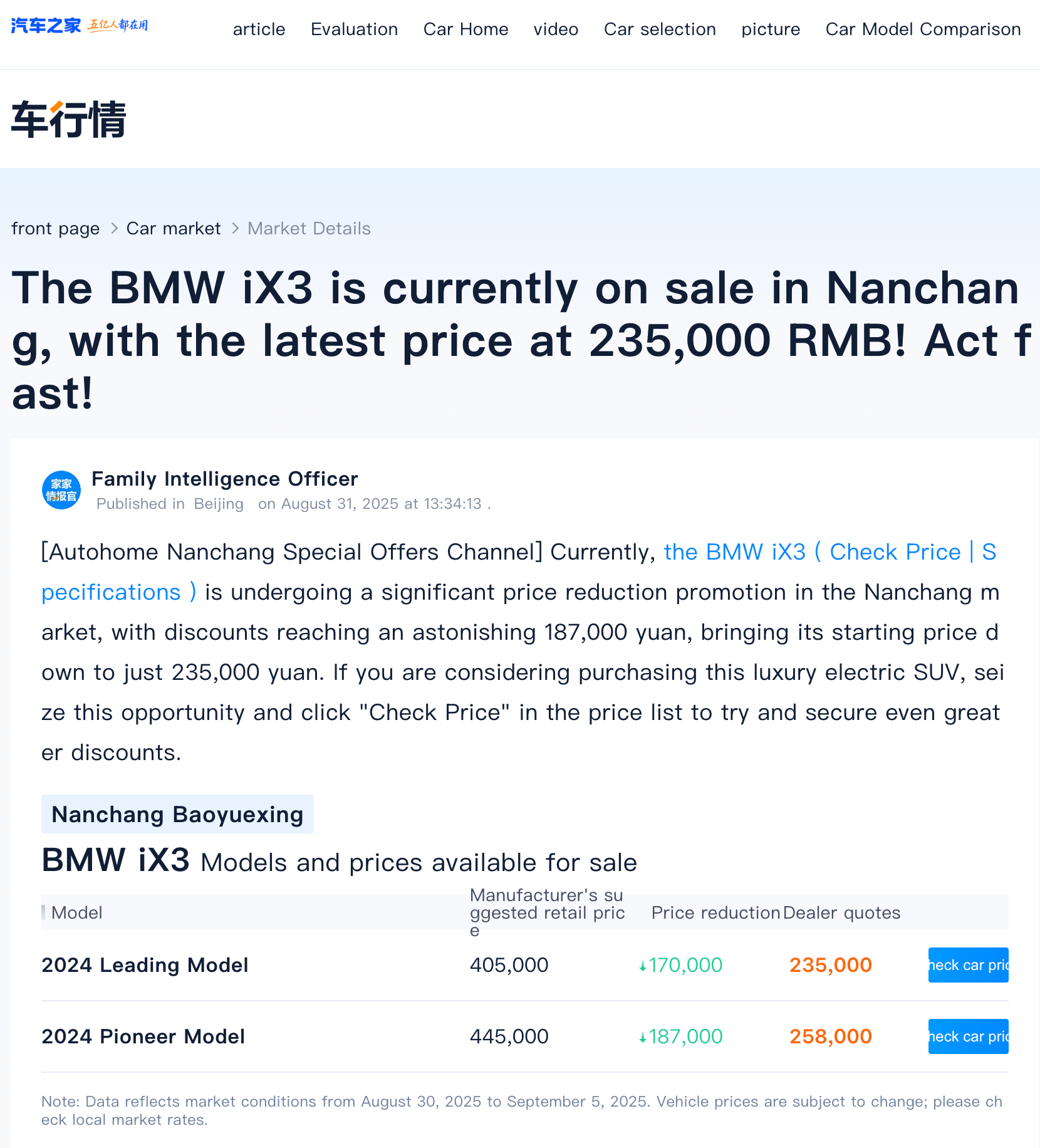
BMW has adjusted its pricing to meet the market and is implementing nationwide pricing in the name of customer experience—credible advertised prices that reduce the perceived need to shop around. BMW hopes to benefit from the corresponding reduction in dealer-to-dealer undercutting.
Mercedes also uses a nationwide pricing model for the electric CLA L and electric GLC L, though it covers the base vehicle and not factory options. Mercedes has one GLC 350 L 4MATIC model on sale for 339,800 yuan at a limited-time nationwide price. Two additional variants have been announced with nationwide uniform pre-sale prices—an entry GLC L 4MATIC model that starts at 299,900 yuan and its six-seater top China trim starting at 388,800 yuan.
Mercedes CEO Ola Källenius, in the brand’s Q2 earnings call, maintained the GLC is differentiated in the China market:
Källenius later made it clear Mercedes is willing to sacrifice some volume to maintain pricing:
[…]
A measured approach towards volume is what I would say at this stage.
Mercedes’ opening pre-sale pricing suggests it is trying to use perceived differentiation to maintain a premium over BMW and local competitors. But pre-sale pricing gives Mercedes the option to adjust the final figures without formally cutting prices—presumably moving them downward, given the intense market conditions that led to subpar reception of the CLA L. Mercedes already did this with the first GLC L variant; pre-orders opened in June at a pre-sale price of 349,000 yuan, but the figure was reduced to 339,800 when it launched in July.
Even with the reduction, Mercedes has so far maintained a pricing premium over BMW at each step of the lineup. The middle models are the most direct comparison: the 299,900-yuan BMW iX3 40L xDrive and 339,800-yuan Mercedes GLC 350 L are both dual-motor, AWD, 800V SUVs with roughly 700 km of claimed CLTC range, but the Mercedes is priced 39,900 yuan higher.
Pricing in yuan as of August 25, 2026
| Model | China Price Range | Note |
|---|---|---|
| BMW iX3 L | iX3 30L: 269,900 yuan iX3 40L xDrive: 299,900 yuan iX3 50L xDrive: 339,900 yuan (nationwide price) | New model on Neue Klasse clean-sheet EV platform |
| Mercedes-Benz electric GLC L | GLC 350 L 4MATIC Huiyin Edition (five seats): 299,900 yuan (nationwide pre-sale price) GLC 350 L 4MATIC Liujin Edition (five seats): 339,800 yuan (limited-time nationwide price) GLC 400 L 4MATIC Xingbo Edition (six seats): 388,800 yuan (nationwide pre-sale price) | New model on MB.EA clean-sheet EV platform; Huiyin, Liujin, and Xingbo are transliterations of the Chinese-market trim names, not official English translations |
| Tesla Model Y | 263,500–313,500 yuan (starting prices) Model Y L: 339,000 yuan (starting price) | Direct global benchmark |
| Xiaomi YU7 | 233,500–329,900 yuan (starting prices) | Direct Chinese smart-EV rival |
| Li Auto i6 | 249,800 yuan (official price) | Direct Chinese smart-EV rival |
| NIO ES6 | 338,000 yuan (starting price; battery included) | Direct Chinese smart-EV rival |
| Outgoing BMW iX3 (G08) | 405,000–445,000 yuan (guide prices) 235,000–258,000 yuan (advertised Nanchang dealer prices, Aug 31, 2025) 253,000–278,000 yuan (advertised Tianjin dealer prices, Aug 17, 2025) | Predecessor to current iX3 |
| Mercedes-Benz EQC | 491,900–571,900 yuan (final guide prices, 2022) 288,400 yuan (advertised dealer price, Aug 2023) | Indirect predecessor to GLC L |
Both brands are seeking to restore volume, competing on price, and using nationwide pricing to gain credibility and assert control. BMW has fixed the price and will have to hold it from reservation through launch. Mercedes is pricing to the differentiation Källenius claimed, even after the market response to the CLA L and a first-half China decline steeper than BMW's. The pre-sale hedge on the entry and top-end variants—and the pre-sale price of the middle variant dropping at launch—reads as uncertainty about whether the market agrees there is differentiation worth a premium.
Now we wait for order signals from both to see whether their offerings drive their desired volume at more competitive price points, and whether Mercedes can hold its premium while doing so.
Genesis · Luxury Claim
The GV90 Shows the Blueprint for Genesis’s Next Product Cycle
New automotive brands have to create a product lineup and broader identity from scratch, and many of their choices reflect the time they launched.
Lexus entered a market skeptical that Toyota could create a world-class luxury car. The original Lexus LS400, launched as a 1990 model, in many ways took the form of the Mercedes models it was designed to compete against, particularly the S-Class it used as a benchmark.
Genesis, launched in late 2015, entered a mature luxury and premium market. To distinguish itself, Genesis models have repeatedly taken cues from ultra-luxury brands above their target competitors while competing aggressively on price.
Reviewers said the GV80 drew comparisons to a Bentley. Throttle House actually compared them:
The conclusion:
The pattern continues with Genesis’s new electric GV90, which, in its top-of-the-line Neolun trim, has coach doors like the Rolls-Royce Cullinan and offers layers of luxury that go beyond those of its typical competitors.
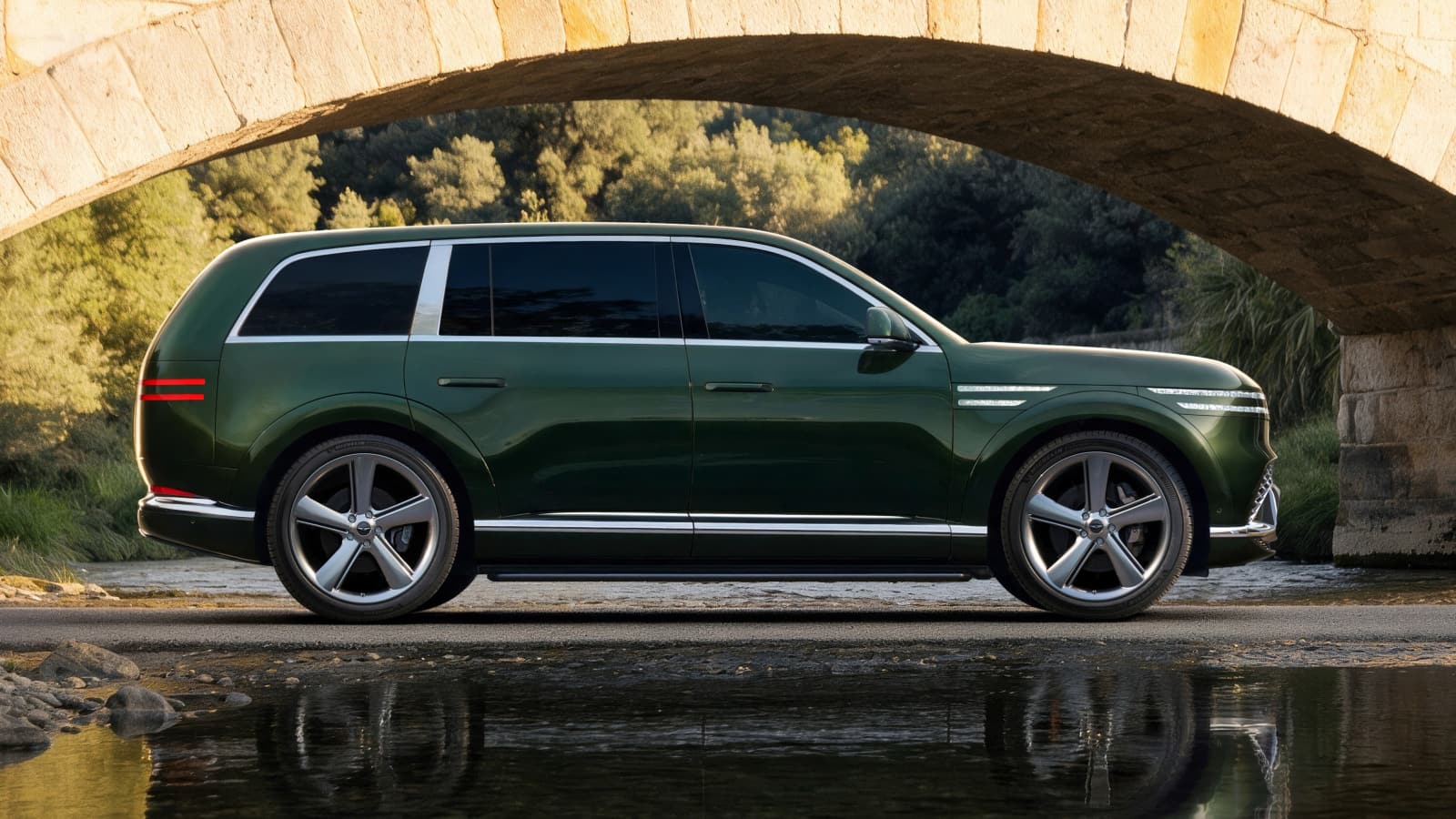
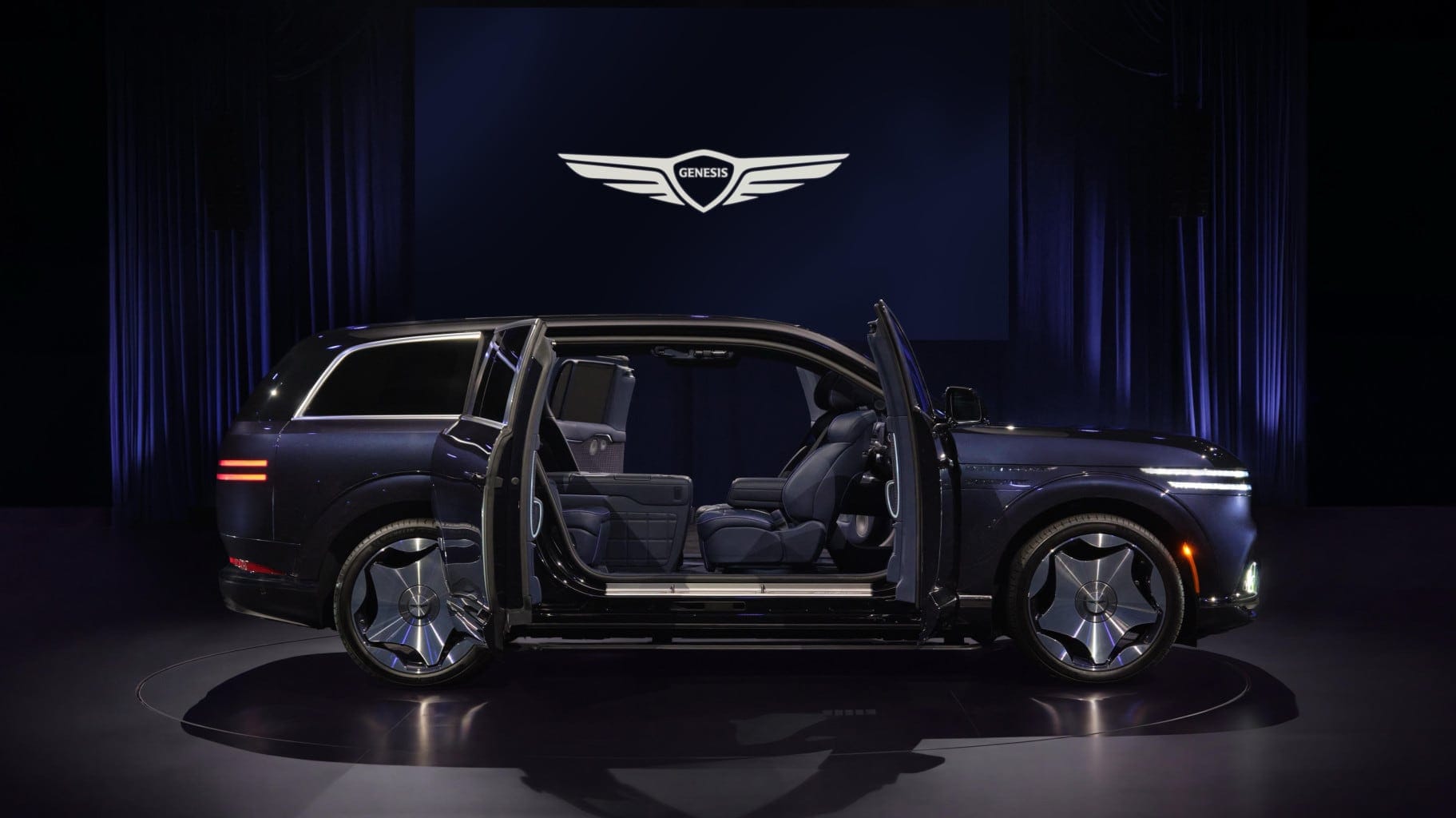
C/D’s GV90 model page:
That Car and Driver put the GV90 and Cullinan together demonstrates the uplift effect of Genesis’s approach. The brand’s bet is that the GV90 will stand out to buyers considering a BMW, Mercedes, or Audi in the same price range.
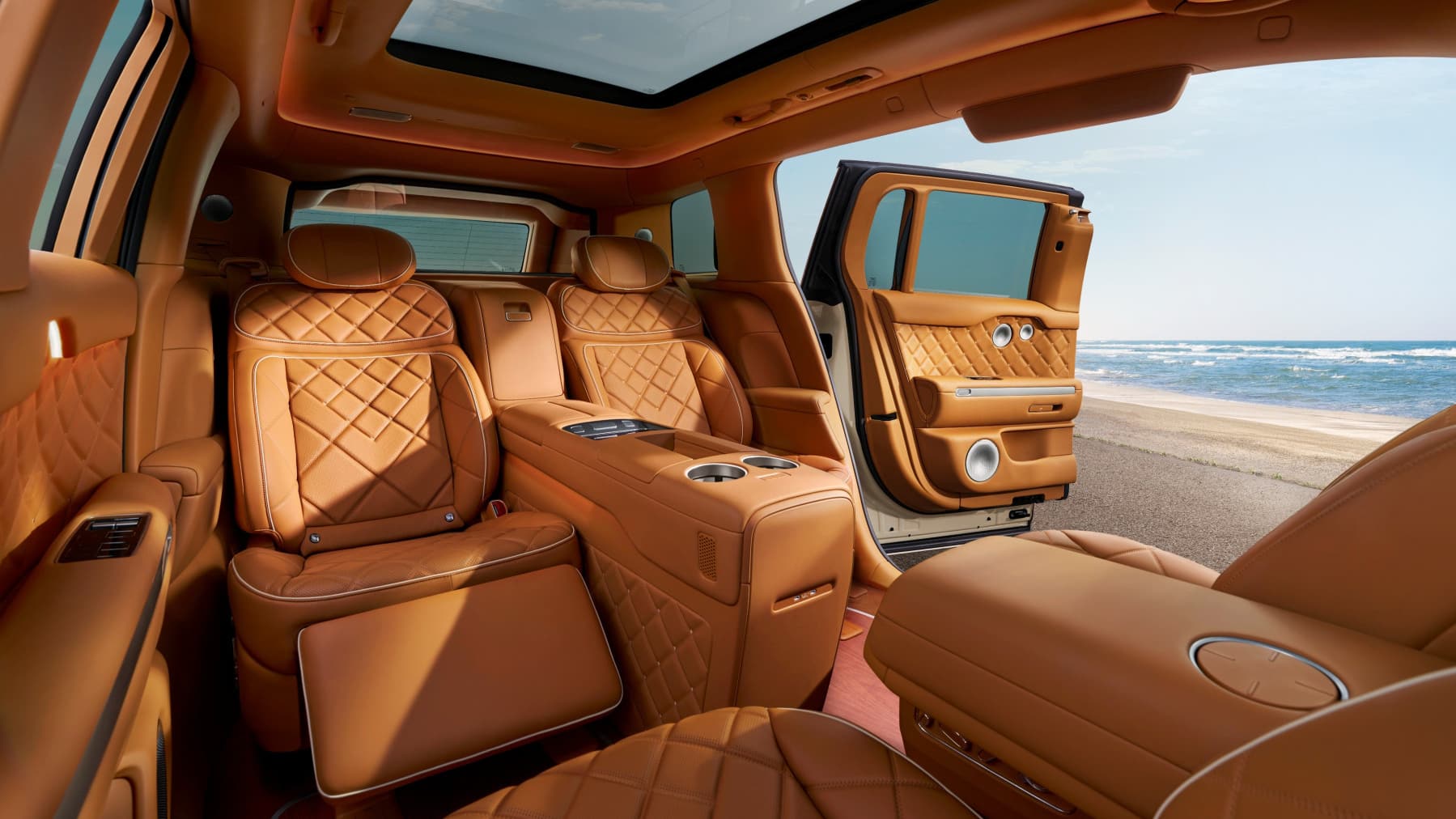
And maybe buyers in China. Though Genesis didn’t mention China in its GV90 news release and its current China sales are marginal, the brand’s target of 350,000 annual sales by 2030 includes expanding its market presence in China and other regions. The GV90’s strong focus on rear-seat luxury seems tailored to Chinese-market preferences: a four-seat Executive Suite, refrigerator, tables, privacy blinds, and six-zone variable-transparency roof, underpinned by a long 3,245mm (127.8-inch) wheelbase. Genesis previously fielded an Electrified G80 sedan in China with an extended wheelbase and features like VIP seats and a 27-inch display, suggesting Genesis sees rear-seat features as important to the market.
It’s critical for a brand to establish a unique and resonant identity. That’s often hard to discern in the early years, when a brand is defined by its initial products. Genesis has benefited from associations with Bentley and Rolls-Royce, but lasting customer loyalty depends on something more durable: a distinct brand identity that transcends comparisons and individual product cycles, then compounds into heritage.
The Throttle House reviewers saw signs of a Genesis identity in the 2021 video: “Knock-off jokes aside, the new G80 sedan and incoming GV70 do represent a huge step toward Genesis having its own character, one that we think it quite rightly deserves.” The “quad lamps”—an implementation of the brand’s “two lines” design motif—and the grille on the GV80 distinguish it when placed next to the Bentley it’s so often associated with. Genesis references Korean design elements in the GV90 news release—“ondol” underfloor heating and exterior flourishes inspired by the moon jar (a symbol of traditional Korean aesthetics).
And while the Neolun’s coach doors force an obvious comparison to the Rolls, the implementation of the “Neolun Arch Gate” is novel:
Being both all-new and a flagship, the GV90 foreshadows Genesis’s upcoming product cycle. While the model continues the pattern of evoking Bentleys and Rolls-Royces, it delivers its ultra-luxury cues through Genesis’s own innovation, with a unique flair rooted in the brand’s home-country heritage. What to watch next is how far and how coherently Genesis carries its distinct innovation and flair across the upcoming lineup.