
Mercedes-Benz Q2 2026 Earnings
Mercedes’ new BEVs are gaining traction in Europe, but weak economics and a failed first China test of its next-generation BEVs leave management more confident in its strategy than the results support
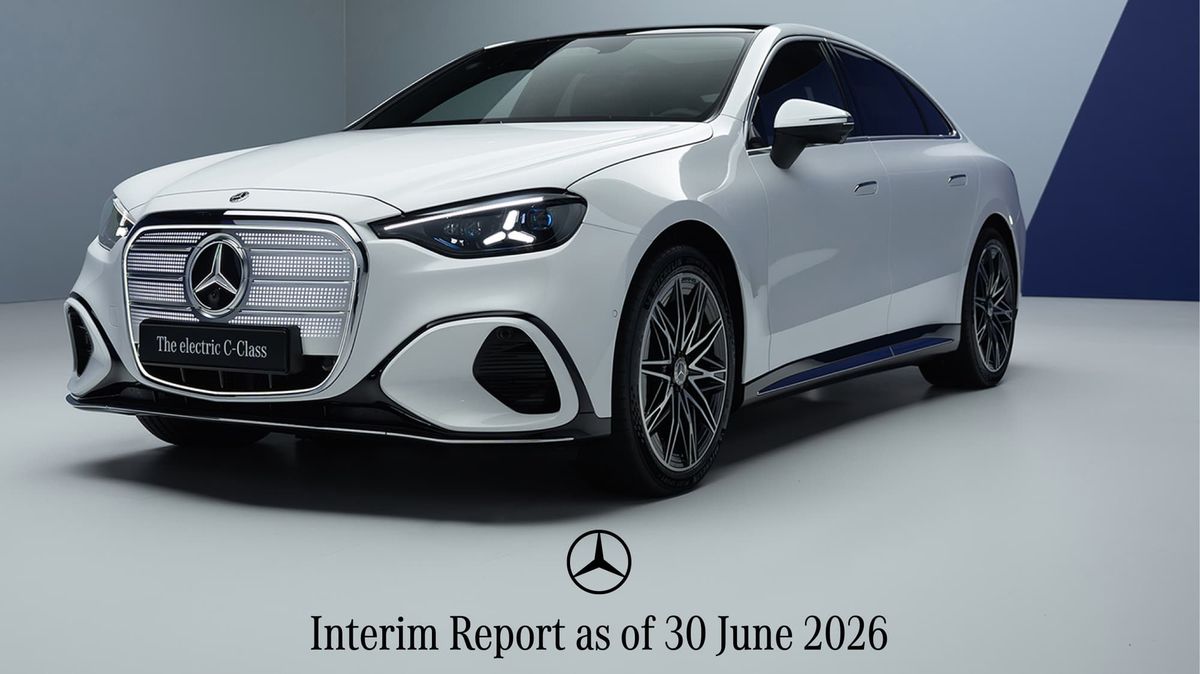
Mercedes-Benz Group management called its second-quarter results “solid,” but the Cars business tells a weaker story: a decline in China overwhelmed better performance elsewhere, while its reported China sales fell materially faster than the overall market. The China market’s discouraging initial response to Mercedes’ first next-generation BEV heightens concerns about the brand’s ability to recover there.
Mercedes-Benz Cars sold 417,765 vehicles in the quarter, down 8% from a year earlier. Europe rose 4%, the U.S. rose 10%, and Mercedes says global sales excluding China increased 2%. China fell 30% in Q2, with declines across every product category. Full first-half China sales declined 28.3%. That was materially worse than both the roughly 20% contraction in domestic passenger-vehicle retail sales and BMW Group’s 20.4% decline in combined BMW and MINI deliveries, although the measures are not directly comparable.
Rising sales outside China did not translate into stronger Cars business economics. Revenue fell 5%, adjusted EBIT fell 26%, and adjusted return on sales declined to 4%. Mercedes says fixed costs were already 19% below 2019 levels as of 2024, net of inflation, helping cushion the margin while pricing and mix remain weak. The Next Level Performance program builds on that base with further fixed- and variable-cost reductions and lower investment. Top-End segment volume, which includes S-Class models and the G-Class (G-Wagon), fell 10% and did not provide the mix support Mercedes’ strategy requires. China-related impairments reduced reported Cars EBIT to €49 million and signal that management now expects less future profit from its joint ventures. Mercedes expects second-half profitability below the first half, while relying on improved Top-End mix and pricing support—neither visible in Q2—to meet its fourth-quarter expectations.
The product evidence is encouraging in Europe, but negative in China. Mercedes’ BEV sales rose 51% globally and 87% in Europe, while European BEV orders more than doubled.
But the first meaningful China market test of its new BEVs has seemingly failed. The CLA L combines Mercedes’ latest technology—the MMA architecture, MB.OS, and Momenta driver assistance—with a long-wheelbase body tailored to China. Yet Bloomberg (via Automotive News) put its first-half volume at only 1,153 units. Mercedes’ stronger global technology and localization inputs did not translate into demand.
Because the CLA sits in Mercedes’ refocused Entry Luxury segment, the result does not yet isolate the failure. It may reflect the CLA’s position in a fiercely contested part of the market, a broader weakness in Mercedes’ localized product proposition, or both.
The Core Luxury GLC L should provide a more discriminating test of whether Mercedes’ China-specific product and technology strategy can rebuild demand there at sustainable pricing. Management is optimistic about the locally produced electric GLC L, which adds China-specific five- and six-seat layouts and localized digital systems. CEO Ola Källenius said, “Everything that makes a Mercedes a Mercedes” is in the GLC L, and made it clear that Mercedes would work hard to protect pricing and “wouldn’t buy market share at the expense of burning cash.” The test is underway: the first GLC L variant went on sale in China in July, after the quarter closed, with the remaining versions—including the six-seat layout—open for pre-order ahead of a fall launch.
The open question is diagnostic rather than operational. Management appears convinced that its product strategy and Next Level Performance efficiency plan remain fundamentally sound: that execution, timing, and external conditions explain the gap, and staying the course will restore Mercedes’ position in China. The results leave open the more threatening possibility that Mercedes’ brand proposition, portfolio strategy, or response may not be enough.
The contrast between Mercedes’ Q2 framing and BMW’s response to its earnings is noteworthy. Mercedes-Benz Cars and the BMW marque posted nearly identical global-volume declines in Q2—8.0% and 7.7%, respectively. At Group level, BMW reported stronger growth in Europe and the United States during Q2 and a materially smaller first-half decline in China, although it does not disclose directly comparable BMW-marque regional figures. BMW’s new CEO called the first two quarters “not satisfactory” and communicated an operating reset; Mercedes called Q2 “solid” and continues to defend its established plan.
That does not establish that BMW’s core brand is healthier—its brand-only economics are not disclosed. It does reveal a striking difference in diagnosis and response: BMW is treating weak results as grounds to intensify structural change across its organization, processes, and cost base, while Mercedes appears to regard weaker relative performance in China as a problem its existing product and efficiency plans can still solve.
Mercedes’ new BEVs are gaining early traction in Europe—meaningful product progress—but their first China test has failed. Management’s confidence currently runs ahead of results.
The earnings read against Mercedes’ Big Questions:
- Luxury Economics and Portfolio Discipline moves materially negative. Negative net pricing, a lower average selling price, weak Top-End volume, and a 4% adjusted Cars margin reinforce the pricing-power problem. Earlier cost reductions are cushioning the result, and Next Level Performance promises more, but the economics have not recovered.
- Technology as New Mercedes-ness receives mixed evidence. European BEV demand supports the product direction, but the CLA L shows that stronger technology and localization have not yet created differentiated commercial value in China. The electric GLC L results are the next proof point there.
- China and Localized Luxury moves negative. Mercedes’ reported China sales fell materially faster than the overall market in the first half, and the company lowered its profit guidance. The GLC L is the next model to watch as Mercedes tests whether localized products and technology can rebuild profitable, brand-consistent relevance, pricing power, and volume.
Update, Aug 13, 2026
An earlier version cited reporting that put first-half CLA L volume at around 650 units. Bloomberg (via Automotive News) subsequently reported 1,153 sales of the electric CLA in China; the difference may reflect differing datasets or measures. Either figure supports the article’s assessment.
Update 2, Aug 13, 2026
Mercedes has since offered a different framing on the CLA’s sales results. In the Bloomberg reporting published by Automotive News, the company said the electric CLA was never meant to drive volume but is instead meant to showcase its latest technology in the Entry segment, and that it is focused on “sustainable growth rather than purchasing market share”—echoing management’s messaging on the Q2 earnings call.
The showcase half of that is consistent with what Mercedes said four years ago. Its 2022 “Economics of Desire” strategy update promised the first product on the new MMA platform—today’s electric CLA—would “showcase the way forward.” But the volume framing is difficult to reconcile with the company’s own positioning of Entry Luxury in the strategy update, which calls this segment the redefined entrance point of the Mercedes-Benz portfolio:
The new entrance point of the Mercedes-Benz portfolio is being redefined with the next generation of vehicles. In the Entry Luxury segment, Mercedes-Benz will reduce the number of model variants from seven to four while significantly elevating the technological substance of these products.
Entry Luxury is also a volume-bearing tier. In the first-half report, it accounted for 27% of Mercedes-Benz Cars sales, against 59% for Core and 14% for Top-End. That does not prove this China-specific electric CLA was intended to be a volume leader, but it does mean Mercedes’ Entry strategy cannot be evaluated solely as a technology showcase.
Beyond that, two recent signals go against the “never meant to drive volume” framing. Bloomberg’s sources say Mercedes is limiting its push for the car until the economics improve, which suggests a response to an unwelcome outcome rather than a plan running as designed. And the “So Mc-Benz” campaign, which put a cheeseburger figurine where the three-pointed star belongs, was built to make the car popular with young Chinese buyers.
The assessment above stands. Even if Mercedes never intended the CLA L to drive volume, a technology showcase must still demonstrate that its technology and proposition are compelling. Shopper accounts in the same Bloomberg reporting suggest important parts of the product were not, while its sources say the price cuts needed to compete more aggressively would leave Mercedes losing money on nearly every car. The Mercedes CLA L Is Not Impressing Chinese Shoppers examines both sides of the problem.
Correction, Sept 06, 2026
An earlier version compared Mercedes-Benz Cars’ regional sales with BMW’s regional results without making clear that BMW reports the cited regional figures at Group level. The text has been revised to distinguish BMW-marque global deliveries from BMW Group regional deliveries and to note that the regional measures are not directly comparable.