Mercedes-Benz

Technology as New Mercedes-ness

Can Mercedes make technology feel like a new and lasting expression of Mercedes luxury—or will democratized technology and accelerating imitation make the brand more interchangeable?

Assessment

Mercedes’ technology strategy is producing more credible products, but not yet a proven cross-market advantage.

Reviews of the C400 EV and electric GLC show the post-EQ direction reintegrating electrification and software with recognizable Mercedes virtues—comfort, refinement, materials, usable controls, and conventional luxury cues. Q2 BEV growth and European orders confirm early commercial support.

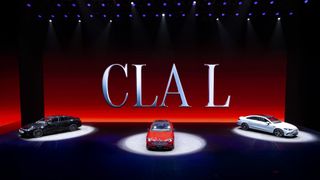
The situation in China is very different. The CLA L combined MMA, MB.OS, Momenta driver assistance, and long-wheelbase localization, yet failed its first market test. That does not prove the technology caused the failure because price, body style, brand momentum, channel, and competition are also plausible explanations. It does show that stronger technology and localization have not yet produced differentiated commercial value there.

The current answer is mixed but directionally positive on the product itself: technology is increasingly feeling Mercedes-like, especially in Europe, while durability, pricing power, and cross-market relevance remain unproven. The electric GLC L is the next test of whether that product direction can translate into demand in China.

Articles

Mercedes-Benz Q2 2026 Earnings

Mercedes-Benz Q2 2026 Earnings

Mercedes’ new BEVs are gaining traction in Europe, but weak economics and a failed first China test of its next-generation BEVs leave management more confident in its strategy than the results support
Aug 06, 2026

Evidence

Mercedes Restores Its Face and Compromises on Materials

First drives of the Mercedes-Benz electric C-Class show the brand reclaiming a recognizably Mercedes face—and building it out of technology—while compromising on interior materials.

Car and Driver concludes the C-Class electric—built on a dedicated, clean-sheet EV architecture—is “more approachable than its predecessor EVs”:

The new C-class EV treads a middle ground: It rides on a dedicated EV architecture separate from that of the regular C-class, but it eschews the weirdness of its EQ predecessors.

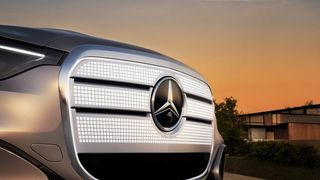
The front carries a prominent grille and a relatively long hood, but the grille is not a traditional part. It is a smoked-glass panel set with 1,050 individually illuminated points that animate when the car is unlocked, locked, and charging, arranged in a pattern that echoes the wide, low grilles of Mercedes' 1960s sedans. The illuminated panel is that shape, rendered in light.

On an electric car the grille cools nothing—it exists to carry brand identity, and it does that through technology. It arrived first on the electric GLC, where Car and Driver called it “fantastic” and R&R read it as a sign Mercedes could make a software-defined EV feel like a Mercedes.

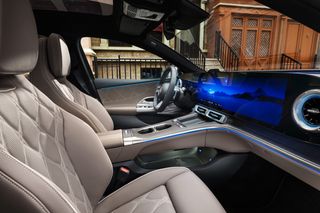
The Hyperscreen carries over too. C/D reached for the same word on the GLC—fantastic—and R&R read it as an additional sign Mercedes could make broadly available technology feel like its own. It is also the more fragile of the two—a large display is something any competitor can buy.

After the EQ design language didn’t resonate with buyers, the brand has restored a recognizably Mercedes face—and built it out of light. Inside, the Hyperscreen carries the same instinct for theater. What is happening at the material layer is less settled, and potentially puts more pressure on the technology.

Car and Driver found the cabin "fittingly upscale—in contrast to the stark minimalism seen at Tesla and its imitators," describing brushed-metal accents, contrast stitching, matte-finished wood, and patterned-metal trim. Motor Trend, reviewing the interior specifically, found that the trim pieces only look like metal and are actually plastic.

It frames the tradeoff customers are being asked to make:

In reality, the cabin has a lot of trim that shines like metal, but a quick fingernail tap reveals it to be plastic. It’s used for the round air vents, door handles, door-mounted seat adjusters, and other pieces of trim. There was, of course, a time when these pieces were indeed made of actual metal. Old-timers might miss that quality and believe it still belongs on a luxury model, even a more entry-level one. But with technology increasing the price of new vehicles, there are probably more customers who appreciate that the look is still shiny and premium—the material swap contributed to efforts to keep pricing in check. For example, although the air vents aren't metal, they are still attractive, especially lit up as part of the ambient lighting.

Motor Trend accepts the tradeoff on the industry’s usual terms: technology raises costs, so savings must be found elsewhere, and many customers will accept visual richness in place of material substance.

The underlying technologies are not exclusive; Mercedes’ differentiation has to come from the way it composes them. The Hyperscreen sits a tier above—the implementation is distinctive, but a large display is not, and nothing stops a rival from buying one and doing it well. The star motifs are the hardest element to imitate directly: Mercedes can distribute its own symbol through the grille, lights, taillights, and roof in a way no rival can reproduce without looking derivative.

So the picture is split. Where Mercedes has put technology to work carrying brand identity, it has worked, and it now runs across the whole car. Where it has compromised, it has trimmed the tactile layer—the surfaces a customer touches rather than the ones that signal to others. What the GLC demonstrated once, a second vehicle now repeats. That turns one instance into a pattern, and it arrives alongside an early counter-signal at the material layer.

The Core segment, which includes the C-Class and GLC, is where the competition is closest, so the first market read will come later this year, when the GLC electric goes on sale, and in the first half of 2027, when the C-Class follows.

The question is whether a halo carried by light and screens holds pricing power as the tactile layer thins.