
Signs of Digital Interior Maturity
Clean-sheet designs let BMW, Mercedes, and Porsche show what more fully realized digital interiors look like
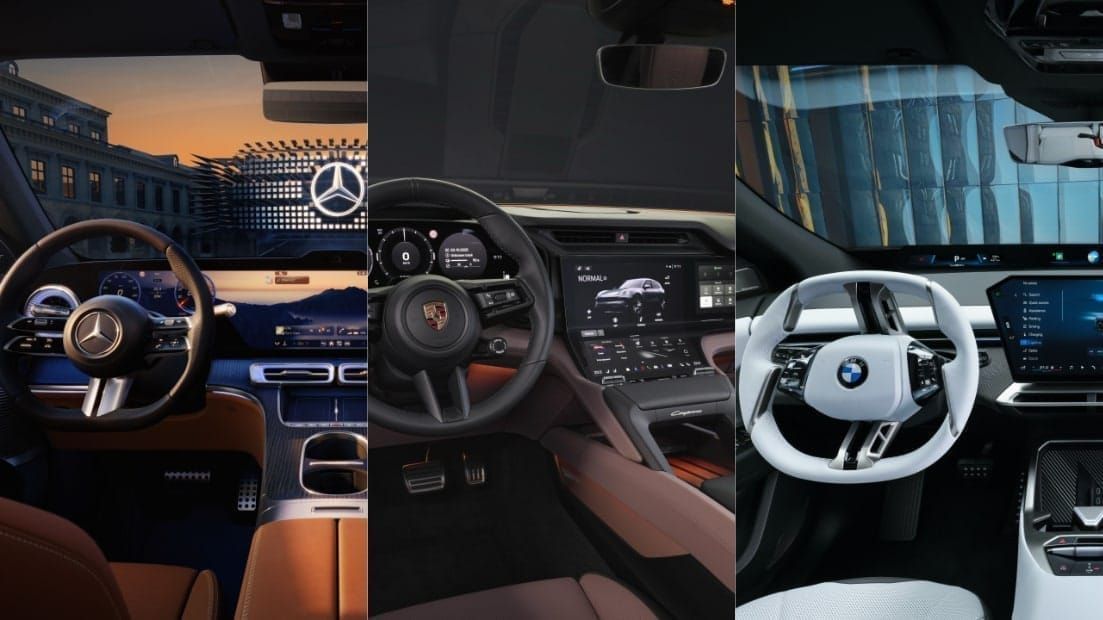
BMW, Mercedes, and Porsche are each launching clean-sheet EVs this year: the iX3 and i3, Electric GLC, and Cayenne Electric. Clean-sheet EVs create an opportunity to rethink everything from packaging and powertrain to software, interfaces, and the basic feel of the cabin.
These particular models are worth watching because established luxury brands often function as the industry’s test beds for new interior ideas and technologies. Luxury brands tend to push the envelope first, which means they often preview where the broader market may go. This dynamic also means luxury brands have amplified both the promise and, frequently, the pain of the last several years of interior change.
The industry’s shift toward digital, electrified, software-enabled interiors has often felt like an awkward adolescence. Screens expanded, physical controls disappeared, and new features proliferated. The resulting interior experiences were often less intuitive, less usable, and less clearly aligned with each brand’s identity. In the luxury space especially, customers often got the excitement of early innovation alongside the frustration of immature execution.
These new BMW, Mercedes, and Porsche interiors suggest that phase may finally be giving way to something more mature: cabins that are still highly digital, but more coherent, more functional, and more clearly shaped around each brand’s identity.
What follows is a look at how BMW, Mercedes, and Porsche are currently approaching this challenge—and what their responses might suggest about where the broader industry is heading.
The Awkward Adolescence
To understand why these new interiors matter, it helps to look back at the awkward phase that preceded them—a stretch in which new digital possibilities, changing customer expectations, and competitive pressure pushed car interiors forward faster than automakers learned how to make them work well.
The basic interaction model of car interiors was relatively stable for decades—the fundamentals like tracking vehicle status and speed, turning, operating windshield wipers, controlling climate, and entertainment worked and were largely consistent across car models and brands.
The initial wave of changes started as incoming consumer technologies—navigation, mobile calling and texting, music on iPods and mobile phones—needed to be integrated into car cabins. The result was infotainment screens that were layered into an otherwise largely unchanged interior.
Tesla, starting with the original Model S, initiated a larger wave of changes. It popularized the modern large-screen, control-minimizing interior more than any other automaker.
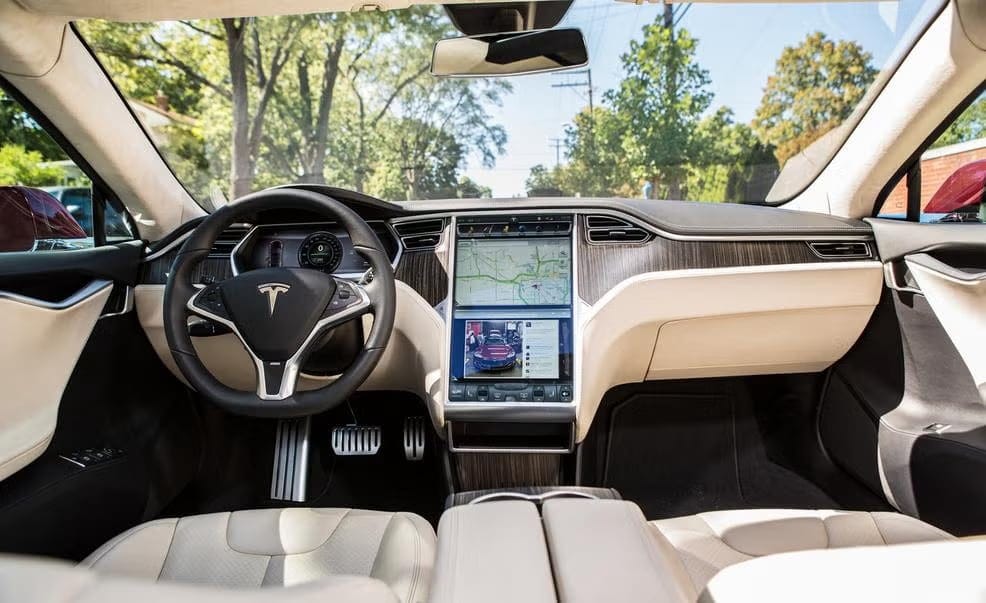
Car interiors have been a recurring friction point ever since, as automakers have tried to balance customer expectations, safety, regulations, innovation opportunities, margin pressure, and the complexity of fitting new technologies into existing vehicle architectures.
Jason Cammisa’s reaction to the then-new 2022 Volkswagen GTI’s interior and broader tech user experience marked a low point:
These days every one of a car's functions, including HVAC and lighting, is integrated into its infotainment UX, and this UX is so bad that it makes you ask: “Did anyone bother testing this in the real world?”
Volkswagen addressed the most egregious issues in a 2025 refresh that replaced the capacitive steering wheel buttons with traditional ones, improved touch sliders for volume and temperature, increased the screen size, and improved the software. But these were reactive fixes, reflective of the way many automakers have integrated new technologies into car interiors and the broader experience.
The problem has been amplified in the luxury space—the price of pushing the envelope. In the 2026 U.S. Vehicle Dependability Study, JD Power said infotainment remained the most problematic category and that premium vehicles underperformed mass-market vehicles in seven of nine categories, with notable weakness in features/controls/displays and driving experience.
Automakers have now had multiple cycles of model redesigns and smaller refreshes that have iteratively improved the situation. That BMW, Mercedes, and Porsche are each launching clean-sheet EVs in the same time window is an opportunity to take stock of their individual and collective progress on interior design.
Clean Sheets
From a pure feature perspective, the new BMW, Mercedes, and Porsche interiors are similar:
- Large and/or multiple screens
- Ambient lighting modes or themes
- App stores or use of third-party apps
- Voice assistants with underlying AI purporting to make the experience more conversational than prior implementations
- Selected controls that remain or are returning to being analog
Taken together, these shared choices suggest each has learned through iterations, knows what its customers expect, and understands current market, technology, and regulatory realities.
The differences in how BMW, Mercedes, and Porsche deploy these technologies, though, are what signal maturity: each is using the same basic ingredients in unique and deliberate ways to serve a specific interior purpose, create a distinct kind of experience, and in some cases rethink the experience itself.
Mercedes’ “Welcome Home” Feeling
Mercedes lays out the experience it wants for its customers in a September 2025 press release focused specifically on the Electric GLC’s interior:
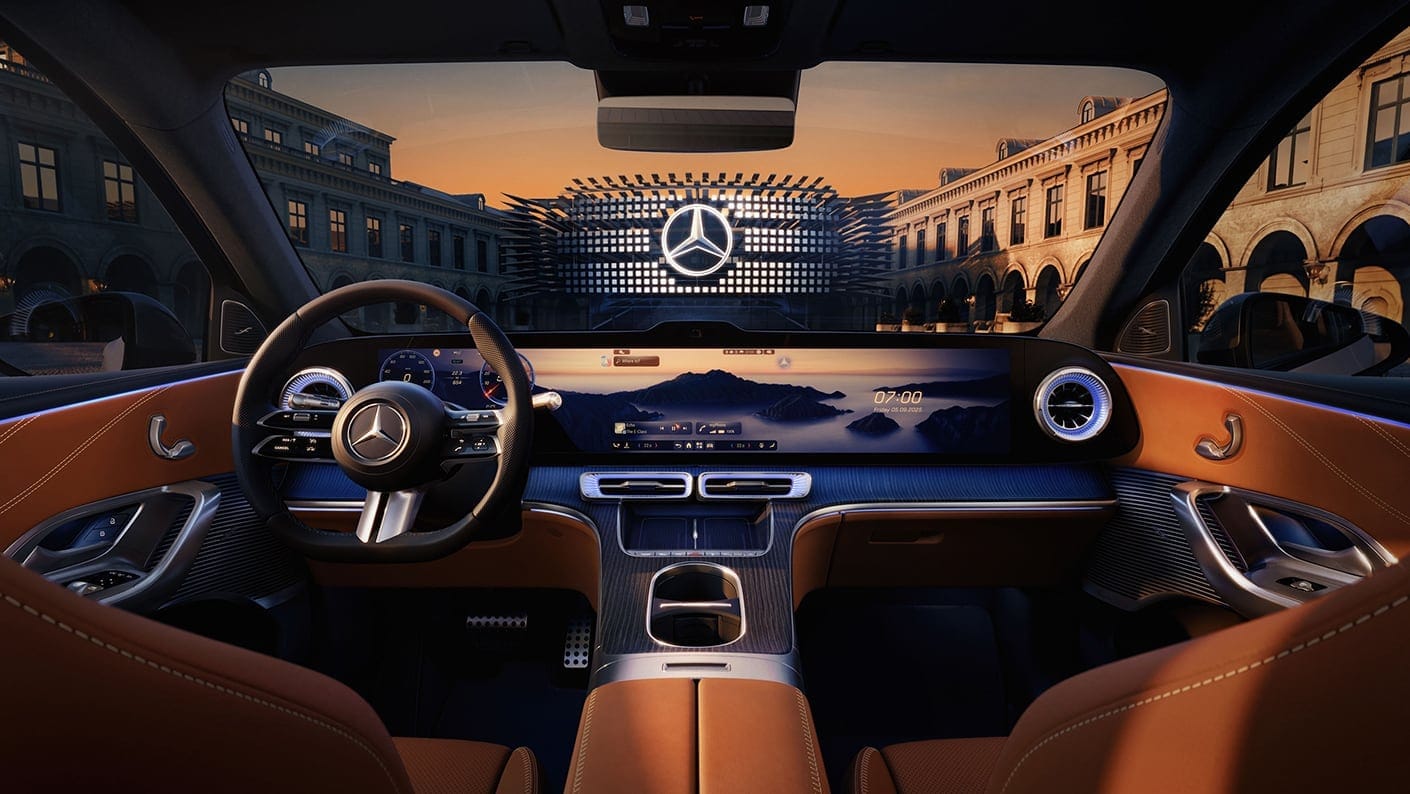
With ambient lighting, eye-catching contours, exquisite decorative elements and the all-new seamless, breathtaking MBUX HYPERSCREEN, the all-new GLC redefines the art of interior elegance and digital convenience. It takes the unique Mercedes‑Benz “Welcome Home” feeling of comfort, safety and reassurance to the next level.
Mercedes then goes into extensive detail on the interior’s sculptural surfaces, ambient lighting, and mood-setting effects—very much in keeping with the brand’s characteristic emphasis on atmosphere and reassurance:
The interior design is further defined by a large decorative sculpture that unifies the center console and instrument panel. A single, sweeping trim element visually unites the two sections into one sculptural surface, elegantly accentuated by ambient lighting along its lower edge.
…
High-resolution atmospheric ambient styles can be selected as background motifs. Their striking design is notable for exceptional aesthetics and precision as well as for its intuitive user navigation.
I haven’t seen one in person yet, but it looks striking in pictures:
As I outlined in Mercedes Holds onto Its Identity, early takes are positive—Car and Driver raved about the Hyperscreen:
The (quite obvious) elephant in the room is the available 39.1-inch Hyperscreen, which stretches across the cabin from one climate vent to the other. It's fantastic, no matter how much you want to hate it.
They also found the interface itself more usable, praising both the controls and the voice assistant:
What's more, the controls are very intuitive and placed in locations that seem to match function. The steering-wheel controls look familiar but have been entirely redone for greater simplicity. The voice controls are very powerful, thanks to a new MB.OS artificial-intelligence operating system, so you don't feel like you're talking at your car, but rather with it. "Can you up the temperature a couple of degrees?" It does it.
Mercedes said it at the top: the interior is designed for comfort, safety, and reassurance. And, it being a Mercedes, to impress.
Porsche’s Dynamic Driving Experience
Porsche’s interior is screen-heavy in its own way, though the brand makes it clear the interior experience is in service of driving. From the Cayenne Electric press release:
In the field of digitalisation, the Cayenne Electric takes the driving experience to a new level. At the heart of the newly developed Porsche Driver Experience is the Flow Display – an elegantly curved OLED panel that blends seamlessly into the centre console and allows clear separation between the display and control areas. It is complemented by a fully digital instrument cluster with 14.25-inch OLED technology and a 14.9-inch optional passenger display. Together, the result is the largest display area ever found in a Porsche.
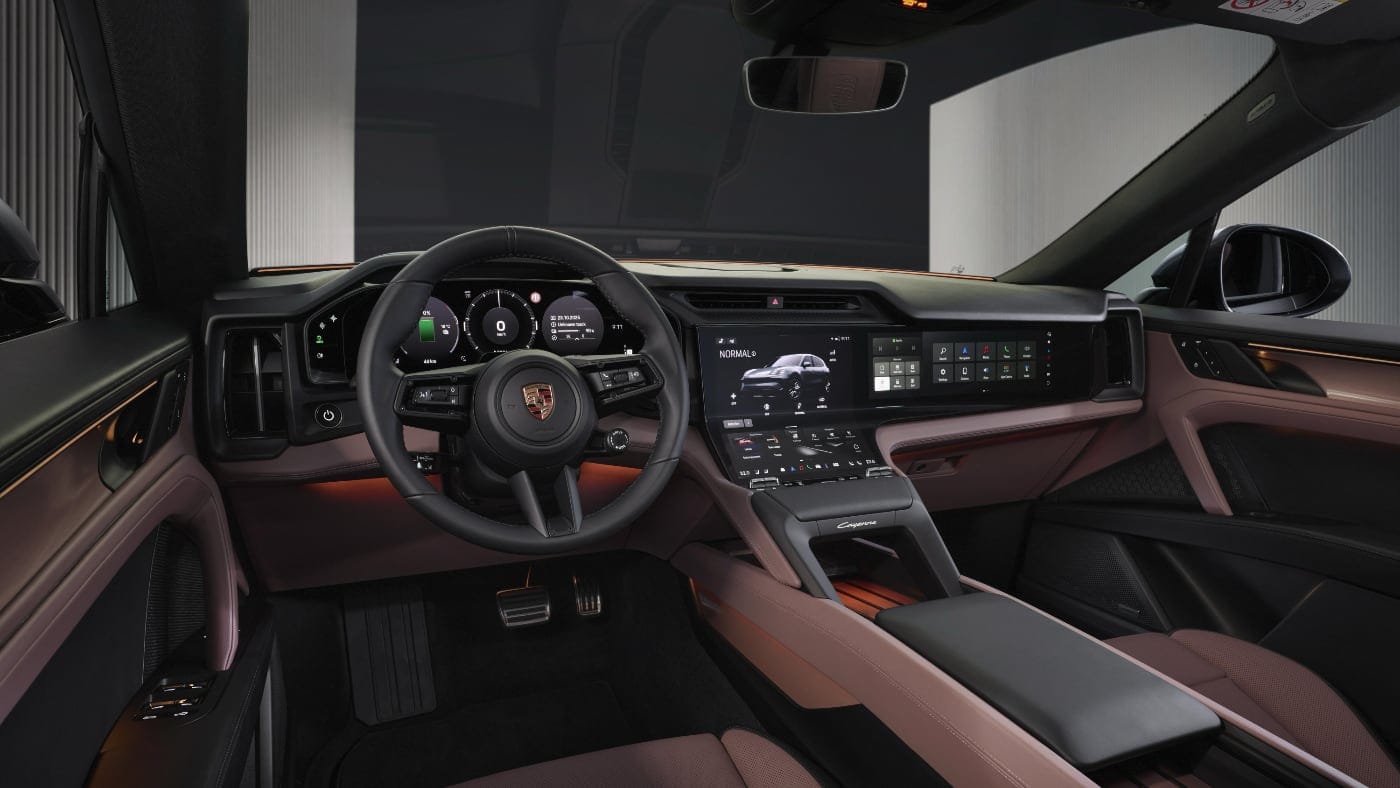
The displays are integrated into the interior architecture—again, this being a Porsche, it’s all about the driving experience:
All displays are seamlessly embedded into the interior architecture. In contrast, the buttons and controls for particularly frequently used functions, such as air conditioning and audio volume, are analog. In addition, a hand rest called the ‘Ferry Pad’ has been developed to enable the driver to operate the digital and analog elements ergonomically – even in dynamic driving situations.
The Flow Display is unique. Car and Driver was impressed by it in their first-drive—and was very enthusiastic about the hand rest below it:
Instead of a flat mass of screens across the width of the dashboard, the Cayenne EV sports a visually impressive 12.3-inch curved OLED touchscreen that cascades down to a couple physical switches for temperature and volume control. Just beneath that is a wrist pad for stabilizing your hand while operating the touchscreen, a feature we didn't know we needed until this very moment. (Put it in everything, Porsche. Please.)
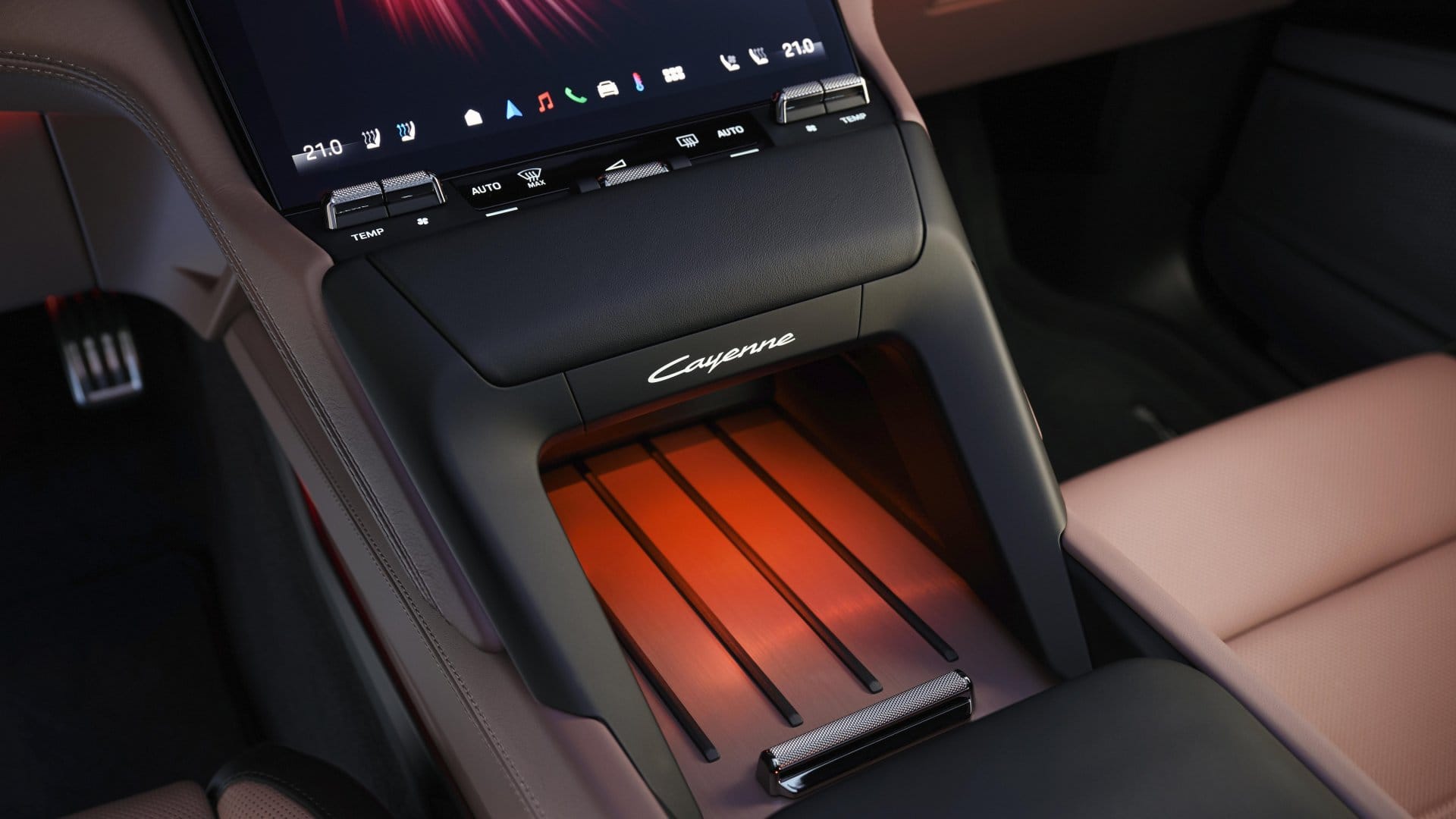
One interesting note: Motor Trend shared what they heard is the origin of Ferry Pad (hand rest) name:
Below the screen, in place of the Cayenne’s traditional hand-holds, is a wrist cushion that Porsche calls the “Ferry Pad,” so named, we were told, when someone saw a photo of Ferdinand “Ferry” Porsche with his hand draped cooly over a car’s gearshift.
Porsche lightly mentions it in the press release and doesn’t actively use the name in their marketing. Mainstream buyers might notice it as a hand rest and move on, but it’s selectively visible for Porsche enthusiasts to discover, recognize, and appreciate. It’s anchored in the brand mythology that comes through in a visit to Porsche dealer or on Porsche’s Heritage page.
Also from Porsche’s Heritage page, at the very top:
We merge classic aesthetics with modern performance to inspire automotive passion.
Their interior seems to broadly follow this philosophy, merging the classic Porsche aesthetic, a heavy dose of digital, and a careful selection of traditional analog controls into a driving-centric mix.
BMW’s Driver-Focused Cockpit
BMW’s press release coverage of the iX3’s interior experience (the i3 is essentially similar) starts with driver focus as its guiding principle:
With its neatly judged balance between digital functions and physical elements, BMW Panoramic iDrive elevates intuitive operation – according to BMW’s “hands on the wheel, eyes on the road” principle – to a new level of driver focus.
Driver focus is a historical BMW signature. BMW talked about its roots in its 2015 40 Years of BMW 3 Series UK press materials:
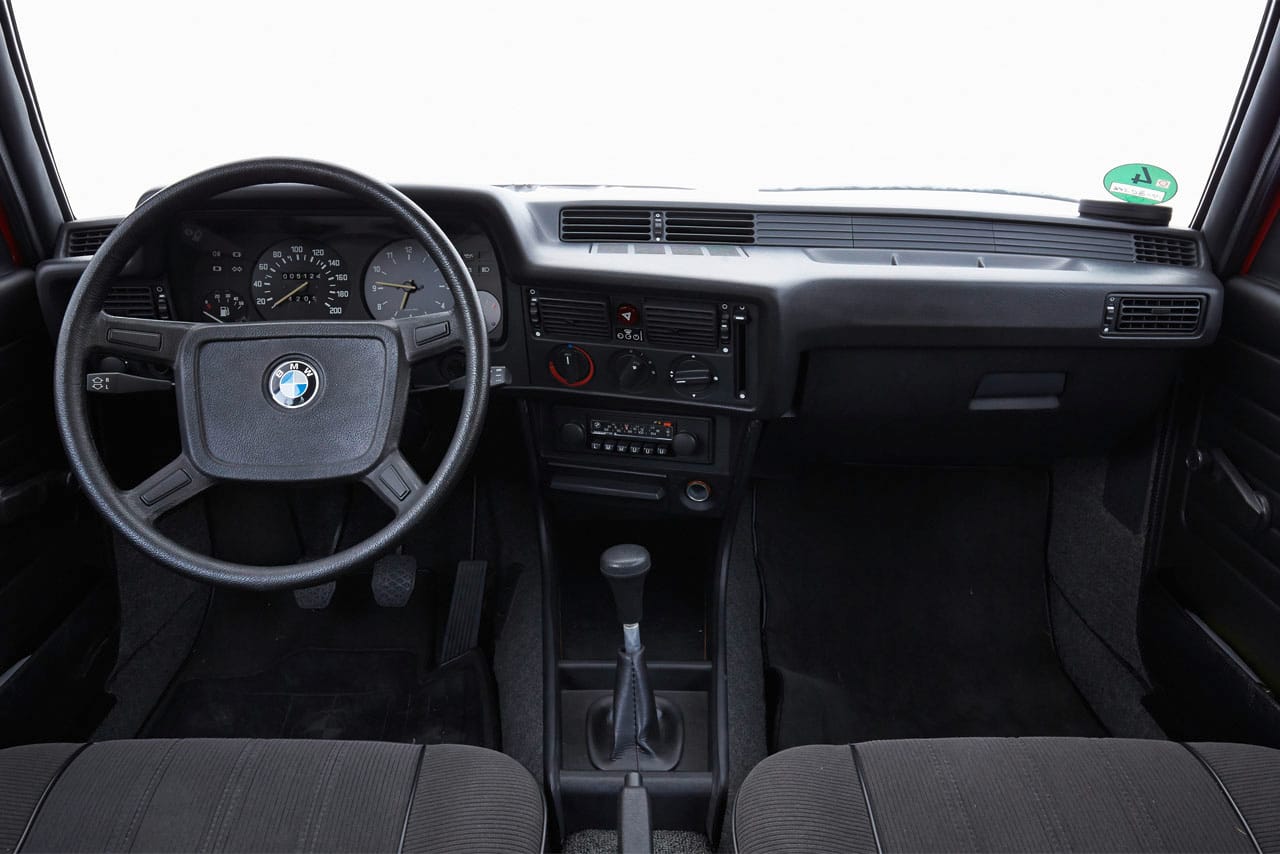
The interior of the BMW 3 Series witnessed the debut of the now familiar driver-focused cockpit design. The vertically stacked controls in the centre of the dashboard were angled clearly towards the driver, making them easier to reach and read. This new development helped to optimise ergonomics and remains a signature feature of BMW models to this day.
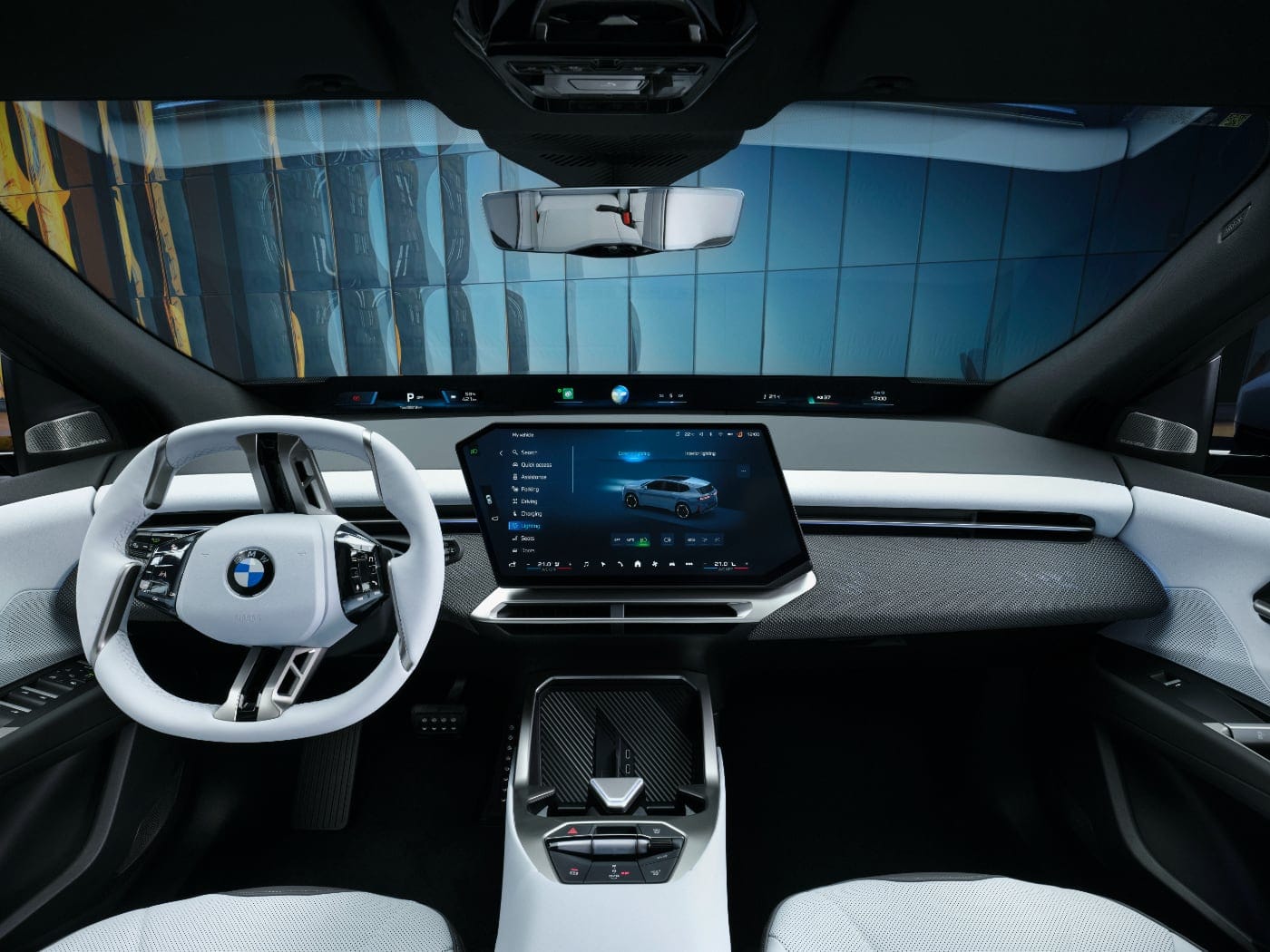
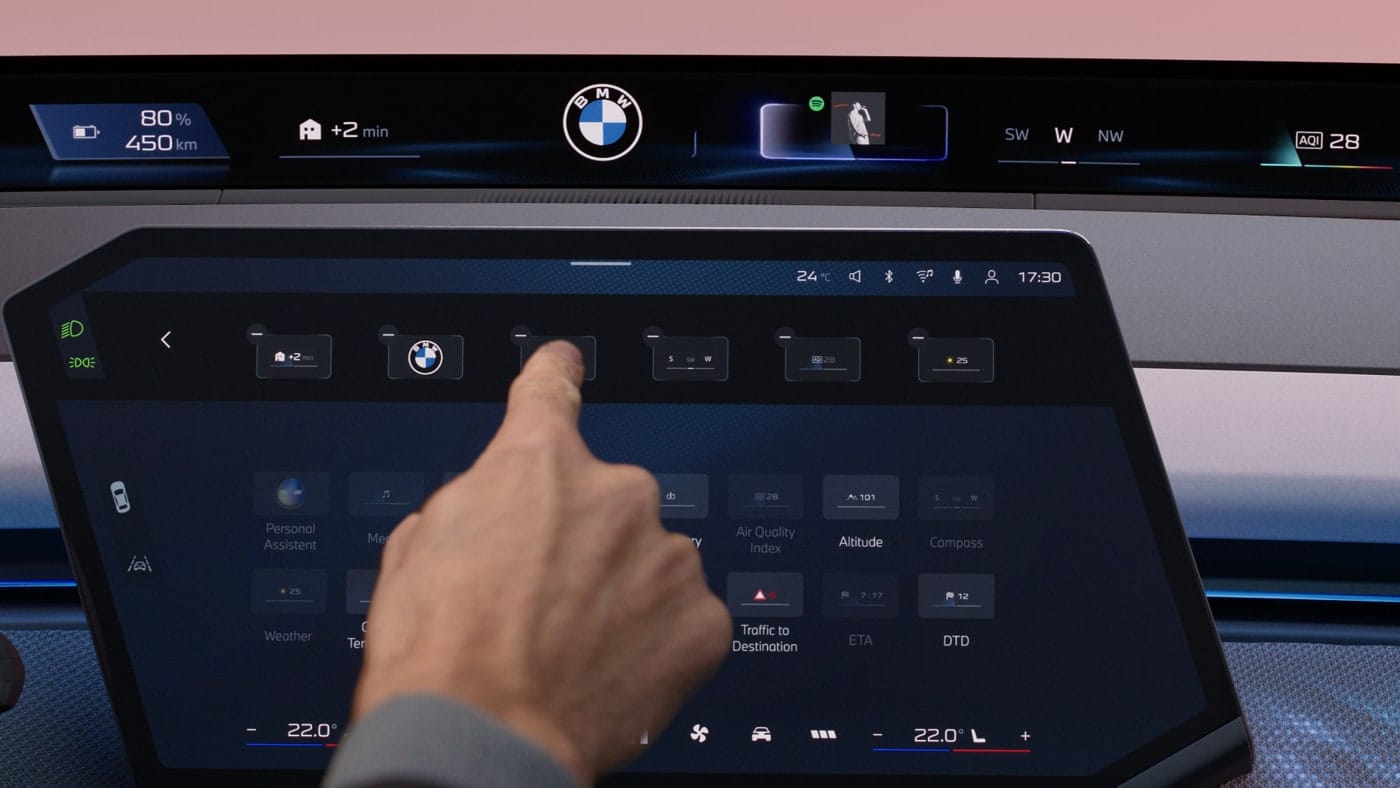
BMW says Panoramic iDrive “reinterprets BMW’s customary ‘hands on the wheel, eyes on the road’ approach, with which BMW sets the benchmark for driver focus.” It appears to be the closest of these three to a rethink of the car interior experience using today’s technology assumptions:
The entire system – consisting of the BMW Panoramic Vision, the multifunction steering wheel, the Central Display, and the optional BMW 3D Head-Up Display – is born out of decades of experience and a user-centric design approach. Individual customer feedback, data from over 10 million connected vehicles, and usability studies with more than 3,000 customers were all incorporated into the development process.
It looks unique…
…though there is a passing resemblance to a modern Tesla interior:
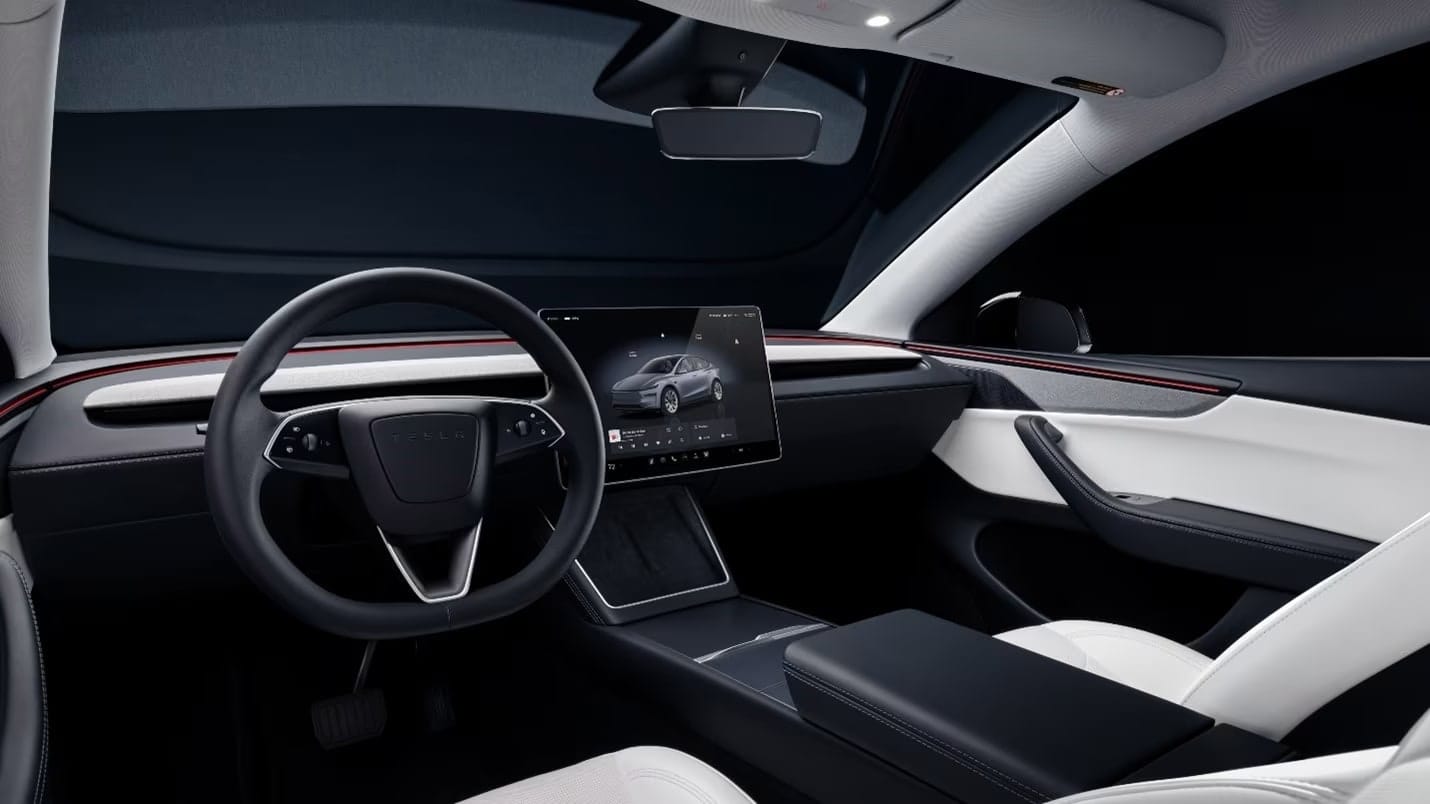
From a distance, the BMW interior may resemble a Tesla or any other interior with a large, centered screen. But BMW is doing something distinct and intentional. There is a through line from its driver-focused design goal to the combination and orchestration of the new Panoramic Vision Display, the uniquely shaped and oriented Central Display, and the selection and layout of controls.
BMW describes the Panoramic Vision:
The BMW Panoramic Vision is a newly developed display concept from BMW for projecting content directly onto the lower section of the windscreen, where information appears on a black printed surface stretching from A-pillar to A-pillar. The information is visible to all occupants and promises a new dimension in driver focus.
Rather than placing key information in the typical location behind the steering wheel, BMW places Panoramic Vision low across the base of the windshield, bringing it closer to where the driver needs to be looking.
The Central Display is responsible for a lot of the functions of a traditional center console. It’s optimized for this role, which requires a more thoughtful approach than a typical infotainment screen:
The 17.9-inch Central Display with matrix backlight technology features a further improved version of the familiar QuickSelect menu structure to enable optimum operation of functions and content by touch. … Operation is highly ergonomic thanks to the Central Display’s shape and positioning in close proximity to the steering wheel.
The Central Display’s “free-cut” (custom) shape is interesting—it’s not a conventional rectangular screen—and makes it easier to reach from the steering wheel. Angled close to the driver, it seems to accomplish the same goal as the more overtly canted center console stack in earlier models, as in the first-generation 3 Series shown above.
Interestingly, the optional heads-up display seems to address a latent annoyance about typical implementations of this feature: elements like speed and navigation are often split or repeated, which, at least in my experience, can create a self-induced back-and-forth between the two:
The new optional BMW 3D Head-Up Display positioned above the BMW Panoramic Vision now shows integrated navigation and automated driving graphics in the driver’s immediate field of vision. The content in the BMW Panoramic Vision and BMW 3D Head-Up Display is presented in a neatly coordinated way.
The two are much closer together, which should make the experience feel more seamless than the typical setup.
Similar to Mercedes and Porsche, BMW held to its original principles. Its design process, which it says drew on years of experience, fleet data, and user experience research, led it to an interior that looks meaningfully different from both the other two and from BMWs that came before it. Starting with a fresh set of technology assumptions enabled BMW to design the interior in ways it believes best deliver a driver-focused cockpit.
Pictures Don’t Do Justice
What we can’t see in pictures and don’t yet fully know from hands-on time is how the software user interface, voice assistant capabilities and behavior, software-enabled features including over-the-air updates, and overall system-level experience will make these vehicles feel in actual use.
BMW, Mercedes, and Porsche talk about intuitive experiences and the ability to personalize things like software interfaces and ambient lighting. Each mentions voice assistants in some form and there’s increasing reference to conversational and generative AI capabilities.
We can see the components, features, and physical designs. The implementation and integration of these other technologies, which have a significant impact on how effectively everything actually works, can only be evaluated through experience.
The early reviews provide an initial take, but the breadth and depth of capability will take time and actual use to fully absorb and assess.
Conclusions
Early indications are that BMW, Mercedes, and Porsche have moved from layering technology and screens onto existing interiors to intentionally designing holistic interior experiences around modern assumptions that work for their customers and brands.
That maturity is visible in the differences between them. These brands are no longer just adopting the same tech trends, but instead are internalizing and integrating technology in ways that are more aligned with who they are.
I think BMW’s approach in particular will be one to watch. Greater driver focus could meaningfully improve driving. Safety is one way: driver distraction is an age-old problem that screens and other technology have often exacerbated. Using those same tools to make driving safer would help validate this transition. BMW’s traditional enthusiast customers might also benefit: a cabin that makes it easier to focus could increase their bandwidth on spirited drives.
Whether Panoramic Vision and BMW’s larger design deliver a safer, more fulfilling experience will have to be proven out by real-world use. The iX3 is selling well in markets where it is available—an encouraging leading indicator. Customer feedback patterns and safety test results will follow, and if BMW’s formula is working, so should broader industry imitation.
The most basic promise of technology is to make things better. If BMW, Mercedes, and Porsche can use technology to meaningfully improve the interior experience—finding more effective ways to realize their long-held principles—the influx of technology, despite the pains of the transition, will ultimately prove a worthwhile step forward. We’ll start to see over the coming year the degree to which each has reached this milestone.