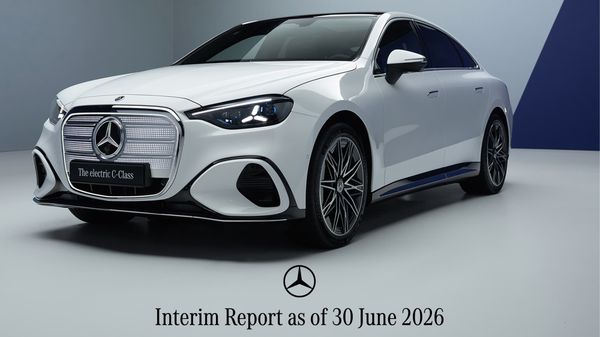
Q2 did not provide evidence that pricing power is rebuilding: net pricing, average selling price, Top-End volume, and adjusted Cars margin all weakened. Cost cuts are buying time; the new product cycle must prove Mercedes can sustain price across all three tiers—Top-End, Core, and Entry Luxury.
Mercedes’ new BEVs are gaining traction in Europe, suggesting technology is again becoming a recognizable expression of Mercedes luxury. In China, CLA L shoppers criticized driver assistance, voice response, and interface design; the electric GLC L is the next test.
Mercedes is showing credible product progress in Europe, but Q2 did not offer evidence that this progress is translating into stronger pricing or profitability. New BEVs are gaining traction there as Mercedes reintegrates software and electrification with recognizable brand virtues.
Pricing, mix, and margins in the Mercedes-Benz passenger-car
Mercedes has not yet shown that it can rebuild pricing power. In Q2, Cars adjusted return on sales fell to 4%; average selling price declined, net pricing was negative, and Top-End volume fell 10%. Fixed-cost reductions and lower R&D spending cushioned the result, but efficiency is
Mercedes’ new BEVs are gaining traction in Europe, but weak economics and a failed first China test of its next-generation BEVs leave management more confident in its strategy than the results support
BMW's differentiation still appears intact, although it is less sharply legible than it once was. Strong demand in Europe and the U.S. shows that its formula remains desirable, while the cohesion of its broad lineup suggests that driving pleasure still gives its blend of performance, comfort, technology,
BMW’s product story is strengthening, but its margin story is deteriorating, with China the largest source of the gap.
BMW’s technology-open strategy has preserved a coherent, desirable lineup through the first phase of the EV transition, while Neue Klasse offers a credible path to advance both its
Tesla is trying to turn the scale and capabilities built through cars into something larger: an autonomy-and-robotics platform with software and service economics. Its automotive base remains commercially strong enough to fund that attempt, but it is increasingly concentrated in the Model 3/Y core, while the tolerance
Tesla has turned its automotive capabilities into a committed autonomy and robotics strategy with early operating evidence, but not yet durable businesses or external platform leverage. The first proof point is Robotaxi scale with visible economics.
Tesla’s tolerance premium appears to survive, but it now depends more on present-tense product and value than mission belief; the open test is whether repeated customer friction exhausts it.