China and Localized Luxury
Can Mercedes remain aspirational in the market where local competitors—particularly EV/software brands—are eroding non-domestic premium advantage fastest?

Can Mercedes remain aspirational in the market where local competitors—particularly EV/software brands—are eroding non-domestic premium advantage fastest?
Mercedes lost position in China faster than the market declined during the first half, and the CLA L failed the first market test of its next-generation localized product strategy.
First-half sales fell 28.3%—roughly eight points worse than the market benchmark cited by BMW—and Q2 declined 30% across every product category. China-related impairments and lower guidance make the deterioration forward-looking as well as current. Sales outside China rose 2%, helping isolate this as a China-specific loss of position rather than a broader decline in demand.
Mercedes’ strategy is coherent on its own terms: local R&D and sourcing, Chinese technology partners, China-specific bodies and digital systems, and a stated refusal to buy share by sacrificing price. But the CLA L already combined the central ingredients—MMA, MB.OS, Momenta driver assistance, and a long-wheelbase body—and available market data put first-half volume at only around 1,153 units. Bloomberg’s shopper accounts now point beyond price to weaknesses in software, interface design, handling, space, and traditional Mercedes luxury; one buyer chose a more expensive Model 3, while further CLA price cuts reportedly would leave Mercedes losing money on nearly every car. The accounts are anecdotal, but they shift the read from an unexplained market failure toward a broader product-and-positioning problem. Mercedes’ deeper version of its playbook did not prove sufficient in this first test.
The locally produced electric GLC L is the next decisive test. If stronger product-market fit can rebuild demand at sustainable pricing, the strategy remains viable. If it cannot, Mercedes will have to confront a deeper possibility: that its brand proposition or portfolio no longer gives Chinese buyers a reason to pay more.
Still the world's largest auto market, China now increasingly sets the industry's cost, speed, and technology baseline—at home and in the markets its domestic brands are entering.

Mercedes’ new BEVs are gaining traction in Europe, but weak economics and a failed first China test of its next-generation BEVs leave management more confident in its strategy than the results support
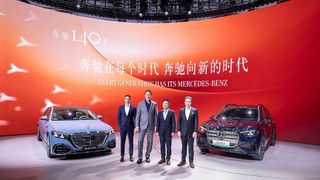
Recent analysis provides insight into the brands’ China challenge and questions whether their former volume can be restored

Both brands seek to regain pricing credibility and control; BMW is committing to lower, fixed figures, while Mercedes is preserving a premium and flexibility

Shoppers who passed on the CLA L cite driver assistance, interface, and space, suggesting Mercedes’ China problem reaches beyond price