Sustainable Differentiation
Can BMW continue to command a premium through exceptional balance while preserving driving pleasure as its organizing principle?

Can BMW continue to command a premium through exceptional balance while preserving driving pleasure as its organizing principle?
BMW's differentiation still appears intact, although it is less sharply legible than it once was. Strong demand in Europe and the U.S. shows that its formula remains desirable, while the cohesion of its broad lineup suggests that driving pleasure still gives its blend of performance, comfort, technology, and usability a recognizable BMW center.
What remains unproven is whether customers value that differentiation enough to sustain pricing power. BMW's 3.6% first-half Automotive EBIT margin is concerning, but does not settle the question because tariffs, currencies, commodities, depreciation, and launch costs obscure the underlying brand economics. For now, the product evidence is stronger than the economic proof.
BMW's clearest historic center was "Ultimate Driving Machine" clarity: a brand and product proposition organized around driving pleasure. Over time, that proposition broadened into an exceptionally complete integration of performance, comfort, technology, and usability.
The same logic extends to powertrain strategy: BMW's technology-open approach has allowed it to accommodate different customer preferences and powertrain trajectories without breaking portfolio coherence or product cadence.
BMW's differentiation challenge is that balance is less singular—and therefore harder to own—than one dominant attribute. That challenge has become more consequential as electrification, shared software/ADAS and supplier ecosystems, regulation, safety requirements, and faster technology cycles are making premium products feel increasingly alike. In this environment, a clear and recognizable identity is what keeps broad competence from becoming generic.
If BMW preserves a driving-led center: exceptional balance becomes a modern, scalable form of differentiation—broad enough to support multiple segments and powertrains, but distinct enough to sustain preference, loyalty, and pricing power.
If driving pleasure becomes inherited marketing language: BMW's broad competence could start to feel generic. Customers would choose more on features, incentives, or availability, weakening loyalty and premium economics.
Throughline: BMW's breadth differentiates only if it remains legibly and distinctly BMW.
Whether Neue Klasse remains recognizably BMW. Its EV and digital advances must become part of an experience still organized around driving pleasure, not merely add up to competitive specifications.
Resolves on: consistent independent evidence across iX3, i3, and subsequent models that steering, chassis behavior, controls, software, and the overall ownership experience remain distinctively BMW; owner satisfaction and retention; and whether that character remains coherent across Neue Klasse EVs and BMW's core multi-energy models.
Open since Jul 2026
Whether exceptional balance sustains pricing power.
Resolves on: evidence of firm transaction prices, restrained incentives, favorable mix, retention and residual values, and resilient underlying margins.
Open since Jul 2026
BMW’s product strategy is holding, but deteriorating economics have prompted management to pursue a faster, more responsive operating model
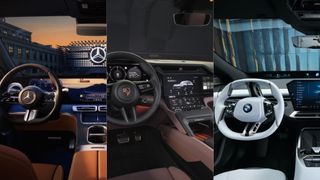
Clean-sheet designs let BMW, Mercedes, and Porsche show what more fully realized digital interiors look like