The Rewired Mercedes S-Class
An update that matters more than it looks
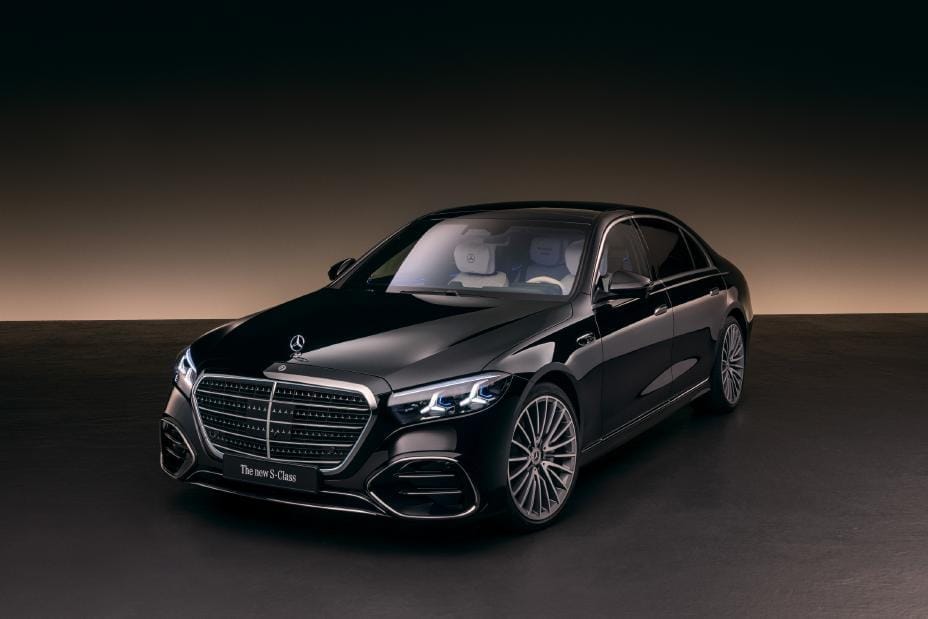
Mercedes-Benz announced the 2027 S-Class, a major update, but not a full redesign, of the existing seventh-generation model introduced for the 2021 model year.
The S-Class, Mercedes’ longtime flagship, carries forward the current body style with some enhancements. Underneath, though, it incorporates the brand’s new software-defined vehicle architecture.
The S-Class update’s new architecture arrives as other traditional luxury automakers like BMW and Volvo also launch their next-generation software-defined vehicle architectures. These architectures lay the groundwork for significant changes in how cars operate, what they can do, how they’re experienced day-to-day, and the ways features are bought and upgraded over time.
The S-Class is generally recognized as the industry reference point for the future of automotive luxury, technology, and safety. Yet it being central to Mercedes’ rollout of its new software-defined vehicle architecture is a unique flex on multiple levels.
A Break from the Usual Refresh Cycle
This update doesn’t follow the recent S-Class pattern: a mid-cycle refresh around the four-model-year mark, and a full redesign roughly every seven.
The current generation debuted as a 2021 model, which means the 2027 S-Class arrives six model years into the cycle. The Mercedes-Benz Media Newsroom frames it as unusually substantial:
With more than 50 percent of the car newly developed, updated and refined, the new S-Class delivers the most comprehensive update for a single S-Class generation to date.
Why does this refresh show up late? Mercedes doesn’t explicitly say, but the timing lines up with what Mercedes had been signaling about its flagship direction: a future where the flagship EV program and flagship sedan branding would converge—dampening the incentive to keep evolving the current ICE/PHEV S-Class on its traditional lifecycle. Autocar:
The next generation Mercedes-Benz S-Class and EQS will be unified under one name as part of a move by the German brand to bring parity between its EV and combustion-engine line-ups.
This means the car maker’s flagship will continue with ICE power in its eighth generation—due in 2030—despite Mercedes previously pledging to replace it with the Mk2 EQS from the end of the decade.
EV adoption hasn’t followed the trajectory many automakers expected—slower-than-expected adoption and regulatory shifts were big factors—and Mercedes has been candid that its EQ series’ “progressive” design wasn’t accepted by buyers .
If the convergence plan slipped or shifted, Mercedes needed the current S-Class generation to stay competitive longer than originally expected. And with MB.OS and the broader software-defined architecture arriving in the same window, this iteration had to be more than the usual facelift-plus-updates refresh.
In that context, the 2027 S-Class reads like a bridge—a belated but unusually deep refresh meant to keep the current ICE/PHEV S-Class competitive longer than the original roadmap likely assumed. Not a full redesign, but more than a typical mid-cycle update.
The Proving Ground
The S-Class is Mercedes’ proving ground for big ideas. It launches ambitious innovations on the flagship, where customers expect unique and novel features. This justifies the high R&D and component costs that typically follow. Mercedes can then validate the features through real customer use and refine the user experience, reliability, and serviceability before rolling them out across its broader model line.
Airbags, anti-lock brakes (ABS), and adaptive cruise control (DISTRONIC) debuted on the S-Class, and LED technology reached a symbolic peak when Mercedes said the 2014 S-Class was “the first car ever without a single light bulb.” Many other features we take for granted today initially took form on Mercedes’ flagship.
S-Class innovations often skew toward safety—it was an early brand pillar, creates a halo for the rest of the lineup, and increases trust. Safety-related highlights from this update include:
- PRE-SAFE Impulse Side focuses on side crashes, where the door can be driven inward quickly because there’s less structure to absorb energy before it reaches the cabin. The feature detects an impending crash and triggers pre-impact measures that use the seat’s side bolsters to help move and support the front occupant before the impact.
- For the rear seats, the S-Class includes rear beltbags (inflatable seat belts) and available rear airbags—features that remain uncommon even in luxury sedans—designed to reduce the forces on the chest, head, and neck in severe frontal impacts.
What tends to get the most attention in a flagship like the S-Class, though, are novel luxury features. A selection from this iteration:
- Heated front seat belts, a cold-weather comfort detail that also nudges better real-world belt fit—which increases safety—by discouraging bulky coats.
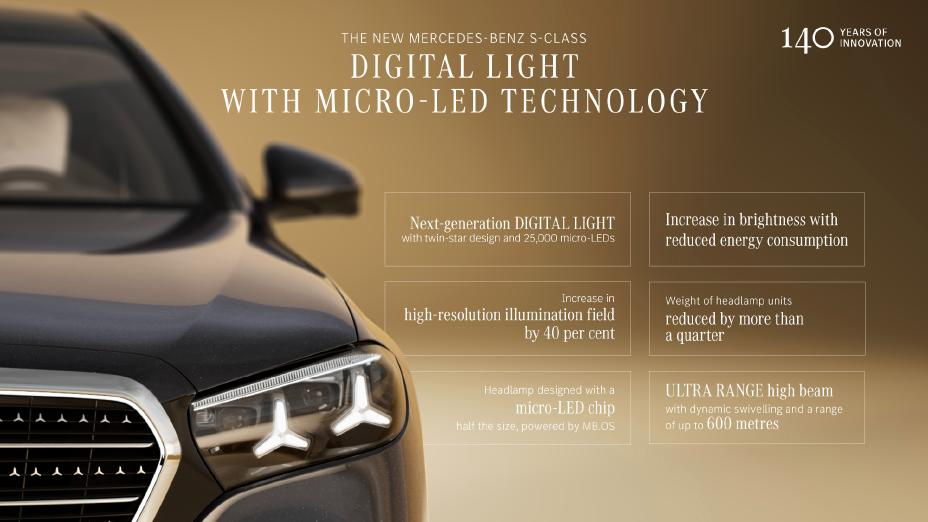
- A new micro-LED DIGITAL LIGHT system expands brightness and usable coverage, adds a swiveling ULTRA RANGE high beam Mercedes says has a reach of “more than the length of five American football fields,” and introduces a U.S.-first “partial high beam” function aimed at better detection of people or vehicles that are hard to see at night.
- A bolder exterior presence including a larger illuminated grille, a new star-themed lighting signature, and (optionally) an illuminated hood star that Mercedes says are designed to turn “every arrival—whether at a grand event or simply returning home—into a memorable occasion.”
- The rear (“boardroom on wheels”) gets larger rear displays, detachable remotes, and integrated cameras that enable video calls from the rear, reinforcing the S-Class as a legitimate mobile office (or a lounge).
The features that get top billing in Mercedes’ announcement, though—right after the exterior presence—are digital features:
- Fourth-gen MBUX (infotainment), including a new Superscreen comprising a 14.4-inch central display and 12.3-inch passenger display under a single glass surface, with an optional 3D instrument cluster.
- Zero Layer, Mercedes’ default MBUX interface that’s designed to surface the most relevant information and actions based on a variety of criteria, has been enhanced with a more smartphone-like interface that includes additional personalization and less menu layering.
- A new MBUX Virtual Assistant that uses what Mercedes calls a “multi-agent” approach that enables more complex, multi-turn conversations (instead of simpler, single-function, one-off requests). Mercedes’ services list includes Microsoft Bing Search, Google Cloud’s Automotive AI Agent, and ChatGPT (4o).
- Digital Vent Control that automates and personalizes vent positioning.
- Faster, broader space recognition and new angled-parking capability in MB.DRIVE Parking Assist.
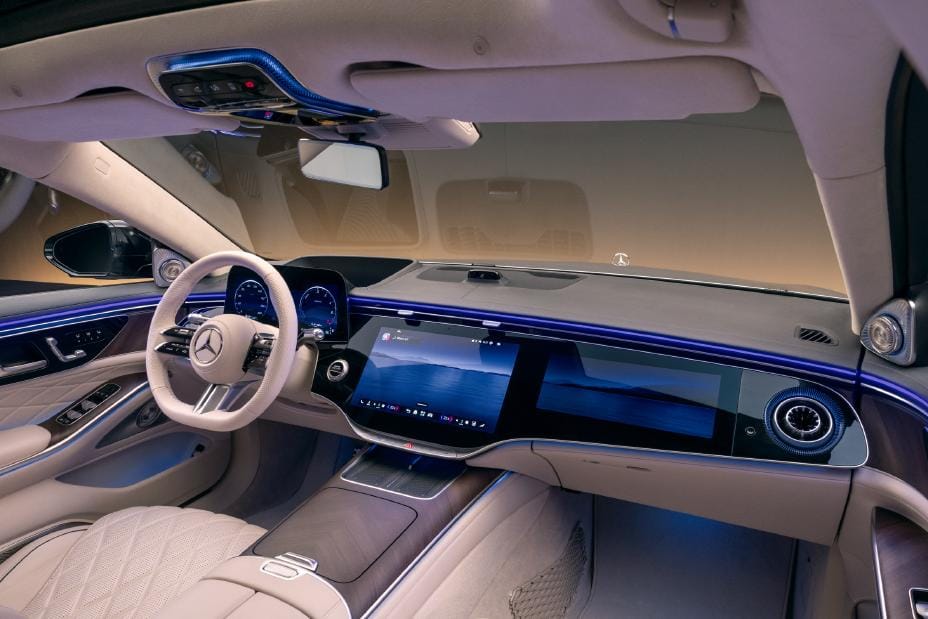
These are just highlights from a very long list.
Yet what gets mentioned at the very beginning of Mercedes’ media release, before almost anything else, isn’t a flashy feature, but an enabler: MB.OS, the Mercedes-Benz Operating System.
The Backbone
Mercedes, right after introducing the S-Class—and after a mention of “new era of visual presence” to reinforce its continuing role as a status symbol—prominently highlights MB.OS. Again from the Media Release:
[T]he Mercedes-Benz Operating System (MB.OS) is the supercomputer behind the new S-Class, powering every domain and integrating all vehicle systems into one intelligent ecosystem. Connected to the Mercedes-Benz Intelligent Cloud, MB.OS enables over-the-air updates for numerous vehicle functions, keeping the S‑Class up to date and refreshed.
Mercedes says MB.OS powers a redesigned “digital backbone:”
The completely redesigned network of powerful computers connected by high-speed ethernet incorporates every sensor, control unit and feature in the car.
This means MB.OS and the broader redesigned architecture drives and/or orchestrates all the features highlighted above:
Mercedes‑Benz Operating System…powers every aspect of the vehicle—from driver assistance to infotainment to driving performance—delivering faster processing, greater computing power and a deeply integrated experience.
This includes features that would typically be associated with a computer or smartphone operating system, like MBUX and the Virtual Assistant, navigation and the rear displays/remotes/camera setup. It also includes the full suite of MB.DRIVE ASSIST and PARKING ASSIST driving assistance features. Newly-digital features, like Digital Vent Control and the DIGITAL LIGHT system (with ULTRA RANGE and partial high beam) are also enabled and/or coordinated through MB.OS.
The functioning of the heated seatbelts is an example of how a software-defined vehicle architecture both enables new capabilities and expands and improves what they can do. Motor1:
ZF’s technology [ZF is Mercedes’ supplier] calculates optimal heating output based on exterior and cabin temperatures, as well as the amount of sunlight detected by the vehicle’s sensors. It even pulls data from the climate control system. This approach eliminates the need for sensors embedded directly into the belt webbing.
The software-defined vehicle architecture enables centralized control and coordination of the vehicle components in ways that couldn’t have been done previously.
The Flex
Mercedes launching its new software-defined vehicle architecture on the S-Class flagship early in the architecture rollout is a flex on multiple levels.
From a surface-level positioning perspective, new foundational technology like MB.OS—which required expensive R&D and includes a lot of innovation—should debut first on the S-Class. The top-of-the-line should have the newest and best.
Yet MB.OS and the redesigned electrical/electronic architecture will roll out across other new Mercedes models in the coming months, not years from now. This is not the usual trickle-down dynamic at work.
From this vantage point, Mercedes launching its new architecture early in the launch cycle on its most complex and feature-dense model introduces real execution risks. That Mercedes is nonetheless delivering it on the S-Class now signals they believe their software-defined vehicle architecture is flexible, reliable, and scalable enough to host its most robust feature set today and to expand on it over time.
Also, traditional automakers making a similar architecture transition—including Volvo, with the EX60 and BMW, with the iX3—often introduce theirs on clean-sheet EV platforms. A ground-up EV platform provides the cleanest foundation to redesign compute, networking, power distribution, packaging, cooling, and validation without having to juggle legacy constraints.
Mercedes, however, is implementing the new architecture on a heavily revised ICE/PHEV platform—where the constraints are far less forgiving than on a clean-sheet EV.
That makes it a meaningful execution flex: this architecture isn’t just “EV-first plumbing,” but something Mercedes believes is robust enough to support today’s most complex feature set on a legacy-derived platform—and scale up and down across the lineup.
Looking Forward
Mercedes makes it clear the architecture has a lot of promise, and every feature it describes is in some form an example of the architecture in action. Still, the flex is implied and subtle. Toward the end of the Media Release, Mercedes makes this mention, almost in passing:
The S-Class also features a new, water-cooled computer with sufficient power reserves for future functions.
While there are light mentions of over-the-air (OTA) updates elsewhere, there’s no elaboration on this point, other than footnotes to features that are promised but will be provided post-delivery via the OTA method.
That Mercedes highlights “sufficient power reserves” is interesting in the context of NVIDIA’s blog post the same day as Mercedes’ S-Class announcement:
Mercedes-Benz is marking 140 years of automotive innovation with a new S-Class built for the AI era, bringing together automotive safety and NVIDIA’s advanced autonomous driving platform to enable a level 4-ready architecture designed for trust.
The new S-Class with MB.OS, which will be equipped with the NVIDIA DRIVE Hyperion architecture and full-stack NVIDIA DRIVE AV L4 software, is designed to support future robotaxi operations—delivering safety-first autonomy with the NVIDIA Halos system and end-to-end AI and classical driving stacks running in parallel to ensure reliable operation.
(Level 4 is the SAE designation for autonomous driving with no human intervention required within a defined operating domain that specifies where, when, and how it works.)
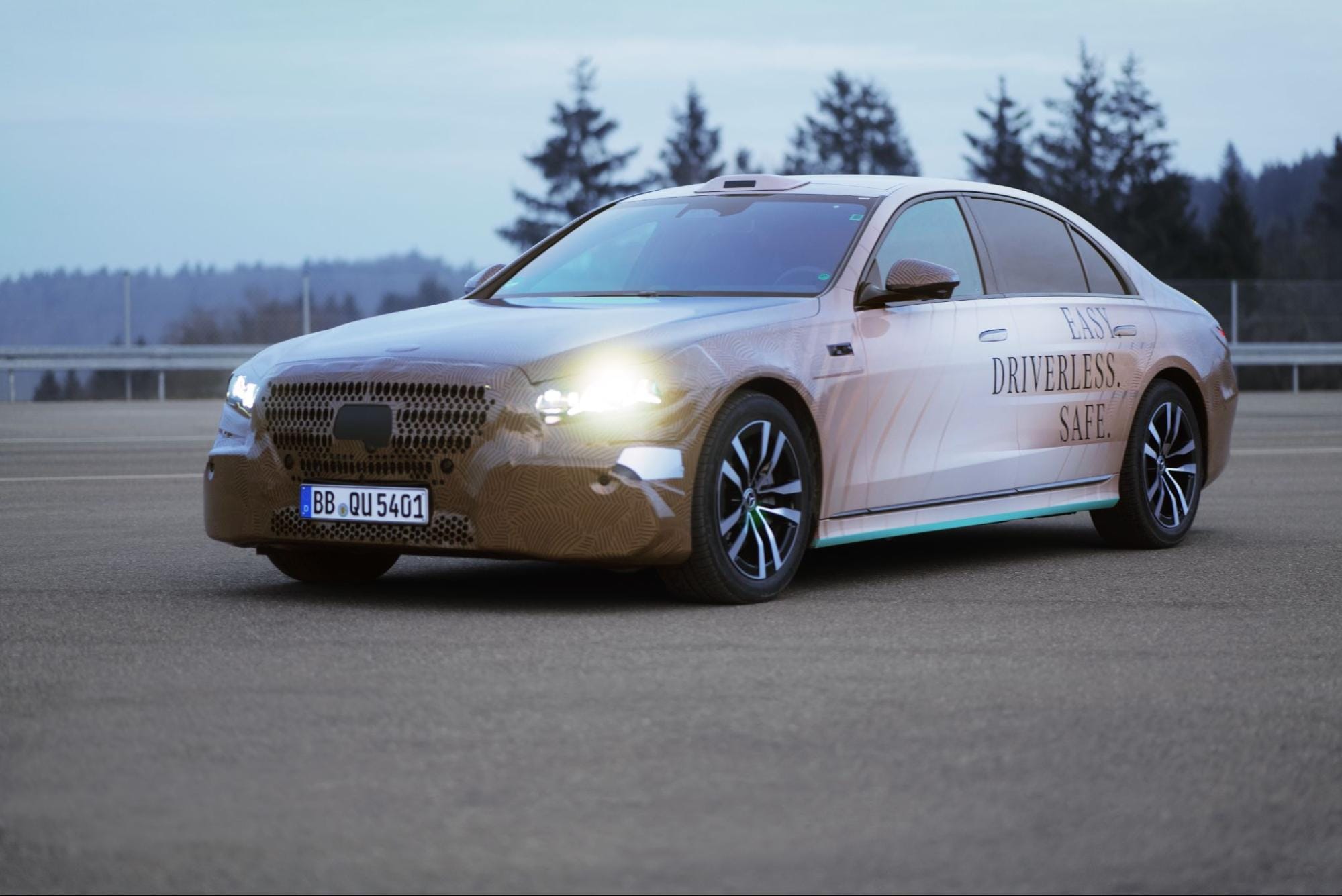
Crucially, this “Level 4-ready” framing is best read as platform headroom—the underlying compute, sensors, and software stack—not as a promised retail feature or an implied OTA upgrade path for privately owned S-Class cars. Mercedes also removed Drive Pilot (Level 3) from the S-Class lineup, underscoring the gap between what the platform could support someday and what Mercedes is willing to sell, certify, and stand behind as a consumer feature today.
That context also helps frame NVIDIA’s emphasis on robotaxi operations: higher levels of autonomy are easier to validate, regulate, and stand behind in constrained fleet deployments than as retail features in privately owned cars.
While Mercedes included the video segment from NVIDIA’s blog post in their World Premiere livestream, there’s no mention of Level 4 or NVIDIA in their release nor in the 2027 S-Class page in Future Vehicles section of their consumer website.
Mercedes’ announcement and its coordinated partner messaging highlight a software-defined vehicle architecture that’s designed to deliver an ambitious feature set that’s visible today—while staying notably restrained about what comes next. Mercedes is showing a combination of caution and discipline in not elaborating here.
Notice the last part of the first line of the NVIDIA quote above: “Designed for trust.” Tesla may commit and push its customers and regulators forward, ready or not; traditional automakers like Mercedes tend to align with regulators and prepare at a pace and with an approach customers will accept.
Expect a flood of software-defined vehicles over the next couple years, particularly from Mercedes-Benz and its luxury peers. Assuming there’s substance behind Mercedes’ architecture flexing, the ever-ambitious S-Class will be a model to watch to experience firsthand the potential of software-defined vehicles—both through what it can do on day one, and over time in how it evolves as software does its magic and unlocks more capabilities.