The Pioneering Tesla Model S
Invention and execution are different frontiers—with different leaders
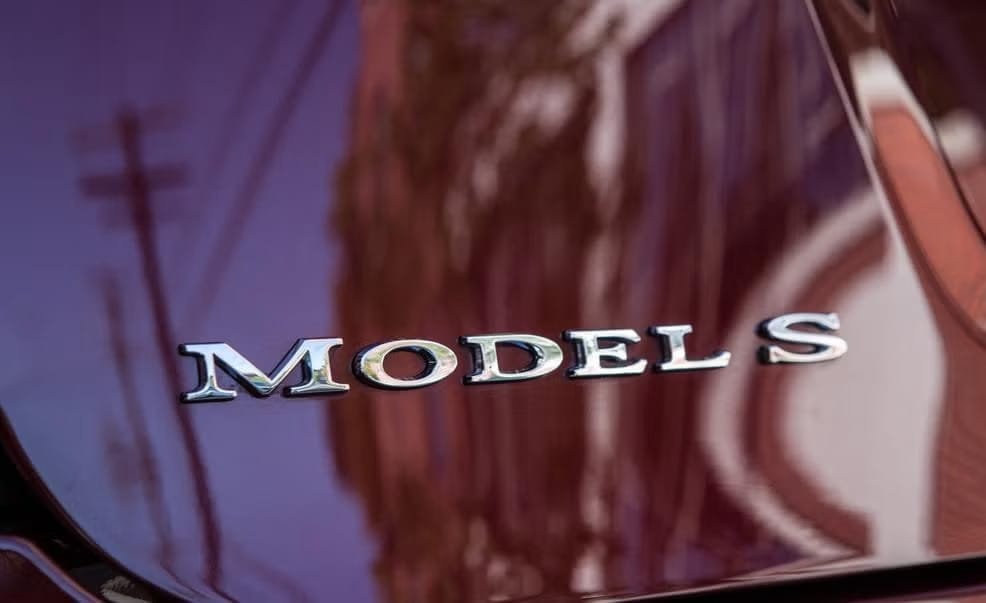
Sometime this coming quarter, Tesla will make its last Model S.
Automotive News delivered a fitting eulogy:
Love it or hate it, the success of the Model S forced every legacy automaker to jump into the race that Musk created—to fill the world with EVs. It changed everything else along the way—and will continue to drive what comes next.
This send-off is right about how the Model S forced the automotive industry forward.
Regarding driving what comes next, though—outside autonomous driving (we’ll see)—Tesla and the legacy of the Model S aren’t the drivers.
Tesla was the pioneer that invented the template for what we now consider the modern car. We’re in a different phase now—the auto industry has learned and is executing against that template.
In an execution phase, the work is different and the role of leaders is different. As is often the case, the leaders themselves are also shaping up to be different.
Tesla’s Trailblazing
Doug DeMuro recently ranked the most important cars of the last 30 years. He put the first Model S at the top:
Unquestionably, in my mind, the number one most important car the last 30 years—it's not even a question, in fact I started this list because I had the number one car in mind—is the 2012 Tesla Model S.
He called it a “cultural touchstone,” saying Tesla became “[A]n Apple with a car”—meaning it mimicked Apple’s business and cultural playbook.
DeMuro also highlighted how remarkable it was Tesla had created an entirely new car company when it was generally agreed there could never be another scaled American company. (Musk reflected on how he’d wrestled with that challenge in 2016’s Master Plan, Part Deux: “Starting a car company is idiotic and an electric car company is idiocy squared.”)
Underlining just how unique it was for the time, the Car and Driver review of the 2012 Model S compared it to both the Nissan Leaf—the only EV it could compare range figures against—and the high-end Audi A7, BMW Gran Coupe, and Mercedes-Benz CLS German luxury sedans.
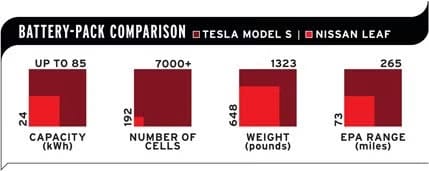
Car and Driver measured 211 miles of range—unheard of at that point—noting it had “three-and-a-half times the juice of the Nissan Leaf’s battery.”
C/D clocked zero-to-60-mph in 4.6 seconds and a 13.3-second quarter-mile pass—performance similar to those V-8 German sedans. The figures didn’t show how instantaneously the Model S responded: “In the Model S, you’re shoved into your seat right now, with an immediacy that no Corvette, Ferrari, or Porsche can match.”
Also previously unseen in 2012:
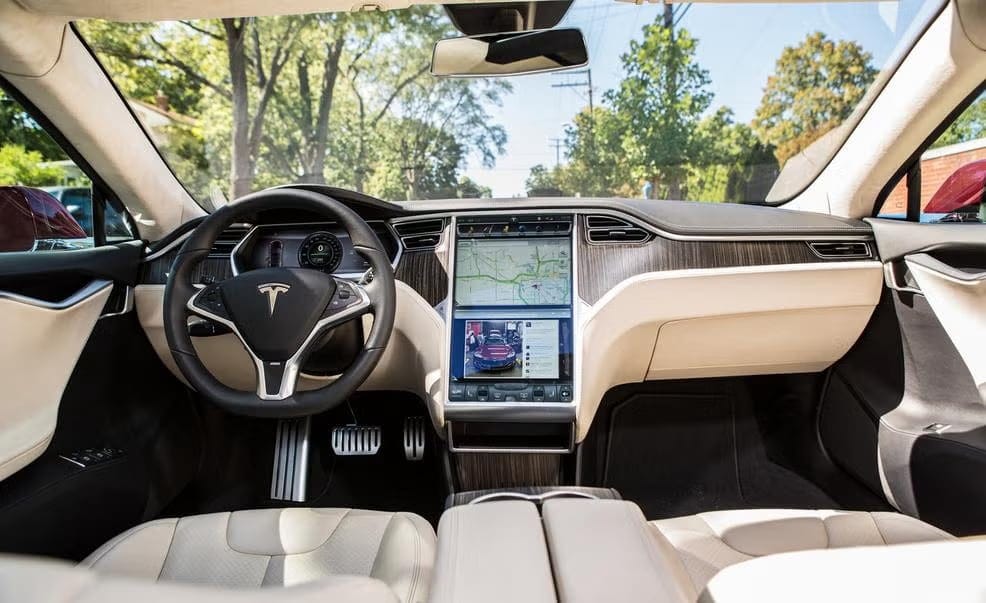
Another unusual aspect of the Model S is an enormous capacitive touch screen that almost completely replaces the knobs and buttons on the dash. It measures 17.0 inches diagonally, is mounted vertically, and presents the area of four to six typical screens.
Compare the highly digital dash above to the Mercedes-Benz CLS of the time:
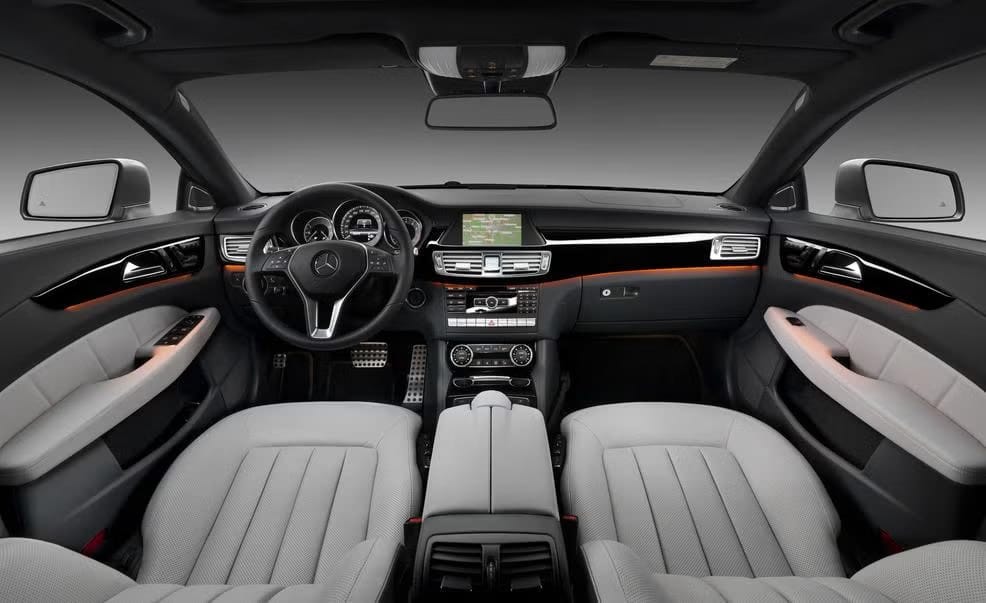
The 2012 Model S looks more like the current S-Class (refreshed in 2022):
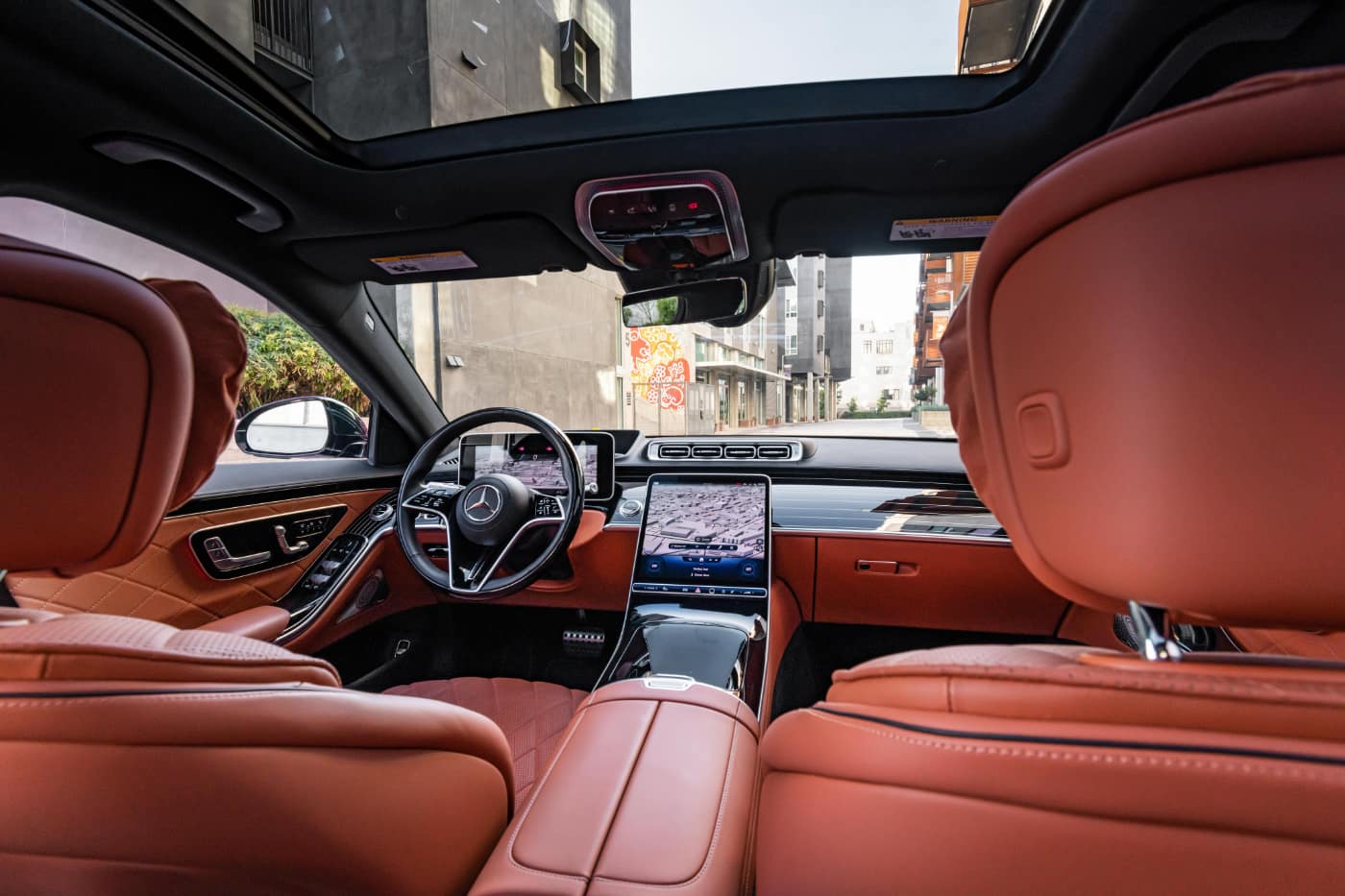
The Model S was built with a platform mindset: connected, centralized, and updatable. This enabled over-the-air (OTA) updates that meaningfully changed how the car behaved and added new features post-purchase—rare in the industry at the time. One big example was Summon, which enabled a Tesla to move itself into and out of parking spaces.
Tesla’s platform approach also meant that features other automakers offered were often executed and integrated far better. Its HomeLink auto-open feature would open your garage door as you pulled up to your home. HomeLink wasn’t new—Tesla productized it as a simple geofenced (location-based) behavior you could set once and forget.
A novel infrastructure layer, starting around 2015, was the Supercharger network, which was built along major highway corridors and enabled Teslas (and other EVs later) to take proper road trips.
In 2015, Consumer Reports gave the Tesla Model S P85D a 100/100—its initial 103/100 score “broke” their rating system, so they had to adjust their scoring to account for it.
The shifts we’ve experienced in recent years and through today—electrification, digital interiors, road-trip-capable fast charging, post-purchase feature updates, today’s push toward autonomy—the Tesla Model S was the start of it all.
Chaos Tax
Tesla didn’t just change what cars could be—it changed how cars could fail. The Model S brought a software-platform mindset to an industry built around model years and dealer visits, and that mismatch created a chaos tax—first for Tesla owners, then for everyone trying to copy the outcomes.
When a car is a computer, failures and updates can affect basic, everyday functions. Early Model S owners saw widely reported main cabin computer failures that took out the center display. That impacted things like the backup camera and defrost controls. And in a different kind of gut-punch, some owners experienced meaningful range drops after software updates intended to protect battery longevity.
Incumbents paid the chaos tax, too. Volkswagen’s ID.3 launch slip is a particularly infamous example. Test drivers reportedly logged hundreds of software errors per day. And VW delivered early cars with functions disabled—promising to turn them on later via updates.
The Execution Frontiers
The Model S exits as automakers—after much trial and error—have absorbed its lessons, and the next phase is execution: realizing the modern vehicle template it created at scale.
The template Tesla invented shifted the car’s defining capabilities to software, electronics architecture, and experience design, layered on top of an EV platform. For incumbent automakers, the template has been expanded to layer these capabilities on top of ICE, hybrid, and PHEV powertrains.
A practical way to evaluate the new landscape is through the following four execution frontiers. Every automaker has to master each. The order, though, is different for new entrants and incumbents.
Entrants need to start with a compelling, differentiated product and then sell enough to prove the case to then scale. Incumbents start with their manufacturing footprint and then factor everything else across it.
1) Cost curve and industrialization
This is making electrification cheaper, easier to build, and more consistent at scale. For incumbents, it’s also about managing mixed-powertrain complexity in parallel so engineering sprawl—the explosion of variants and bespoke systems—doesn’t undermine profitability.
Illustrative leader: BYD is vertically integrated, high-volume, and relentlessly cost-disciplined, so it can drive electrification down the curve faster than most.
Legacy-incumbent example: BMW, which is keeping EVs, PHEVs, and ICE credible without letting complexity and cost explode.
What it means for the product: the “EV tax” shrinks. Electrified options stop feeling like premium experiments and start showing up as default choices at mainstream prices.
2) Architecture and platform propagation
Critical to executing the template across a lineup is a modern vehicle electronics and software architecture. This lets improvements ship fast and spread across a lineup modularly, without each model becoming a one-off software project.
Illustrative leader: Rivian has become both a car company and a platform company. Through its joint venture with Volkswagen Group, it’s turning its architecture into a shared, high-volume software-defined vehicle foundation that VW can roll out across brands while Rivian scales its upcoming R2 and R3 models on the same core stack.
What it means for the product: fewer “this feature exists on the new car but not the old one” gaps—and faster improvements that reach more vehicles.
3) Energy and refueling experience
This is where EVs expose the ecosystem dependency: it’s not just how the car charges, it’s whether the broader experience becomes reliable, predictable, and low-friction.
Illustrative leader: Tesla’s charging ecosystem.
What it means for the product: charging becomes less like planning a project and more like stopping for gas—seamless payment, reliable stalls, and less stress.
4) Trust and stability in software-defined cars
Customers need to trust software updates in their cars the same way they do in their phones. This means updates without regressions, coherent interfaces, predictable driver-assistance behavior, and long-term software support that feels disciplined rather than experimental.
Illustrative leader: BMW has shipped remote software updates at real scale—reporting 10 million successful “Remote Software Upgrades” installed by customers and OTA capability across more than nine million vehicles. While Tesla pioneered software velocity, BMW’s differentiator is software restraint—shipping improvements without making the car feel like a moving target.
What it means for the product: updates you don’t fear—and a car that improves over time instead of degrading or becoming unpredictable.
Onward
Tesla was a single, standout leader that reinvented the car with the Model S.
The landscape has changed. Tesla’s center is no longer cars, despite the strong sales of vehicles like the Model Y and Model 3 that will continue. The leaders of today have learned from the Model S. Every automaker must execute across the frontiers above. No single player will have a monopoly across the expanse that Tesla briefly did.
Electrification keeps moving forward, even if the pace varies by region. Software-defined vehicles are increasingly prominent: EV entrants like Rivian and Lucid innovate on architecture and software while incumbents are introducing next-generation EV platforms and are rewiring their existing cars.
An execution phase isn’t as exciting as an invention wave. Most of what we’ll see in the foreseeable future will be increments on top of what we’ve already heard about or experienced.
This era should be less chaotic, though, because the industry is finally building the muscle the Model S forced it to develop.
And less exciting won’t mean boring: new entrants are showing what a fully integrated modern platform can do with novel features and accessories like Rivian’s heated and cooled Treehouse. We can expect more of this type of innovation across the industry.
So, this period won’t feel as game-changing, but it will also be more stable, and it will deliver more cars that deliver—and expand on—the promise the Model S first demonstrated.