Mazda Says the Quiet Part out Loud
Tradeoffs in a time of transition
Automakers routinely make tradeoffs. They rarely describe them.
Mazda recently did.
In remarks accompanying its latest earnings report, quoted in Automotive News, Mazda outlined specific product tradeoffs in the upcoming CX-5.
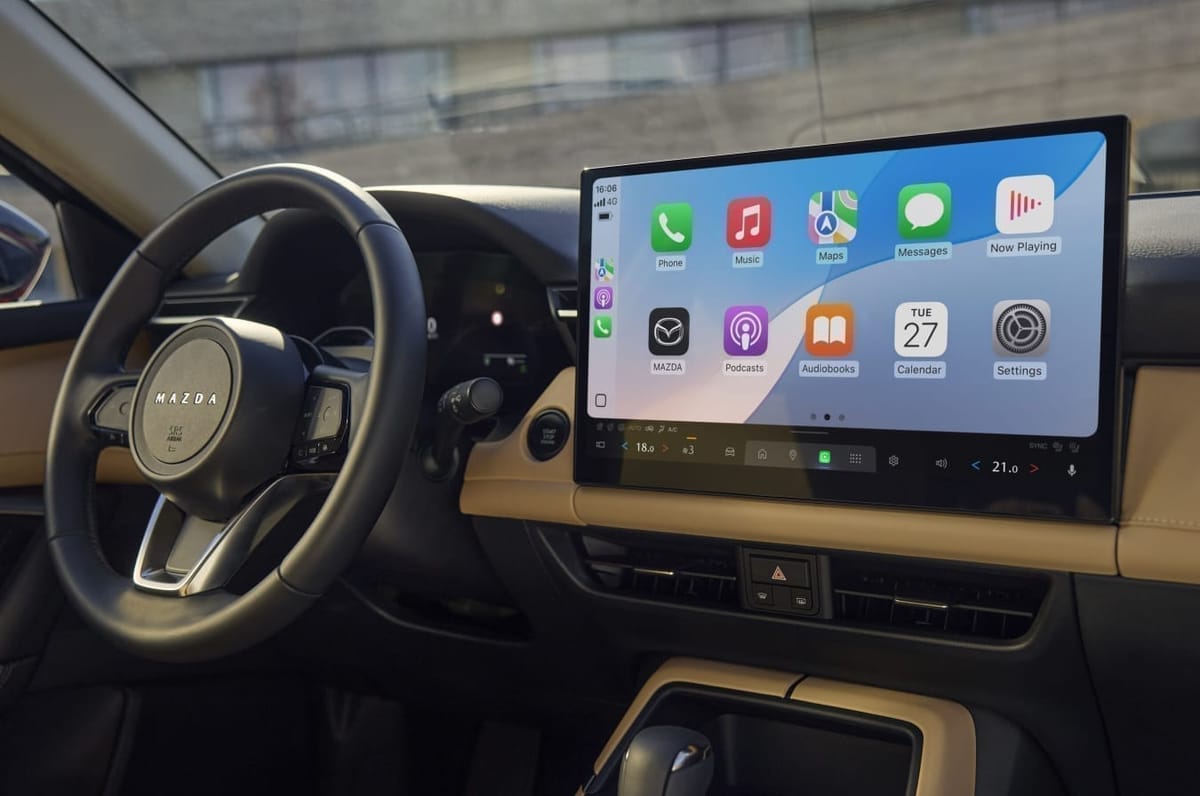
Mazda is performing the same balancing act as the rest of the industry: incorporating technologies consumers expect—large infotainment screens, integrated software, cameras, ADAS (advanced driver assistance systems), connectivity—while maintaining financial viability. This dynamic is widely understood. It is also a recurring friction point within automotive media and enthusiast circles, where the rising dominance of screens, reduction in physical controls, and material simplification inside modern car cabins are often met with skepticism.
What’s unusual is Mazda’s specificity. It is rare for an automaker to describe cost-related product tradeoffs this explicitly. It made the comments while reporting a 32 percent margin decline, so profit pressure was a central consideration.
The CX-5’s execution—and the customer response to it—will signal whether Mazda has allocated its capital wisely. If it succeeds, Mazda’s candor could shape how other automakers handle sensitive tradeoffs.
Customer Values
Autoweek, in Mazda cuts invisible costs on CX-5 to protect margins from tariffs, restore profitability:
The leather on Mazda’s current steering wheels is cut precisely and sewn on a curve so the stitching lines up horizontally. But in the new CX-5 crossover, Mazda abandons that extra cost.
Mazda found that people don’t value it more than the cheaper angled stitching used by rivals.
“That’s great attention to detail from Mazda, but when we look at it, our customers are not really valuing that approach more than our competitors, but it costs us more money,” CFO Jeffrey Guyton said. “Our competitors have an angled appearance to the stitches but the same leather.”
Guyton cited the stitching as one of “many, many, many” unseen cost cuts in the new CX-5.
“Simply, we put money where the customer is going to see it, and we’ve tried to find big cost efficiencies where the customer doesn’t value it as much or won’t see it,” he said.
Mazda here:
- Highlights that the tradeoff, horizontal stitching, wasn’t valued by customers and that the cheaper replacement, angled stitching, is used by competitors (and, by extension, is accepted by customers).
- Notes that Mazda already uses the same leather as competitors.
- Having established its rationale, shares how it applies across the rest of the CX-5, saying there are “many, many, many” cost cuts.
- In their broader follow-on messaging, showcases what customers are getting in return—examples include a large infotainment screen and an improved voice assistant.
The remarks are aimed at investors and dealers (and secondarily employees), but they come with spillover consequences. Mazda is pre-announcing where it made cost-driven decisions, and that will shape how the car gets evaluated by skeptical automotive media outlets and enthusiasts.
Mazda is taking that risk because its position in the industry creates a unique burden of proof.
Mazda’s Burden of Proof
What’s different for Mazda is its scale: it sells about 1 million cars per year, which is small relative to Toyota’s ~10 million, Volkswagen’s ~9 million, and Hyundai/Kia’s ~7 million. Its volumes are also lower than luxury marques like BMW (~2.5 million) and Mercedes (~2 million), which also have significantly higher margins.
Larger mainstream brands like Toyota and Volkswagen are generally more vague in public statements about how they manage costs and improve efficiency; their diversified lineups, platform leverage, and procurement scale are incorporated into investor models, and their overall footprint is a signal of durability.
Luxury brands like BMW and Mercedes carry a higher margin and need to protect the mystique of their products. Customers expect a “no compromises” approach, so overt cost-cutting language is generally undermining.
Mazda, given its smaller scale, the outsized importance of the CX-5, and the rising capital demands of software and electrification, operates with less narrative insulation than either larger or luxury players. It cannot rely on volume, pricing power, or mystique. Given this position, specificity becomes less a communications choice than a structural necessity—a way of meeting a burden of proof that its scale and margin profile impose.
Inviting Scrutiny
This message wasn’t for automotive media, enthusiasts, or customers, but Mazda almost certainly expected the story would spread.
And it has:
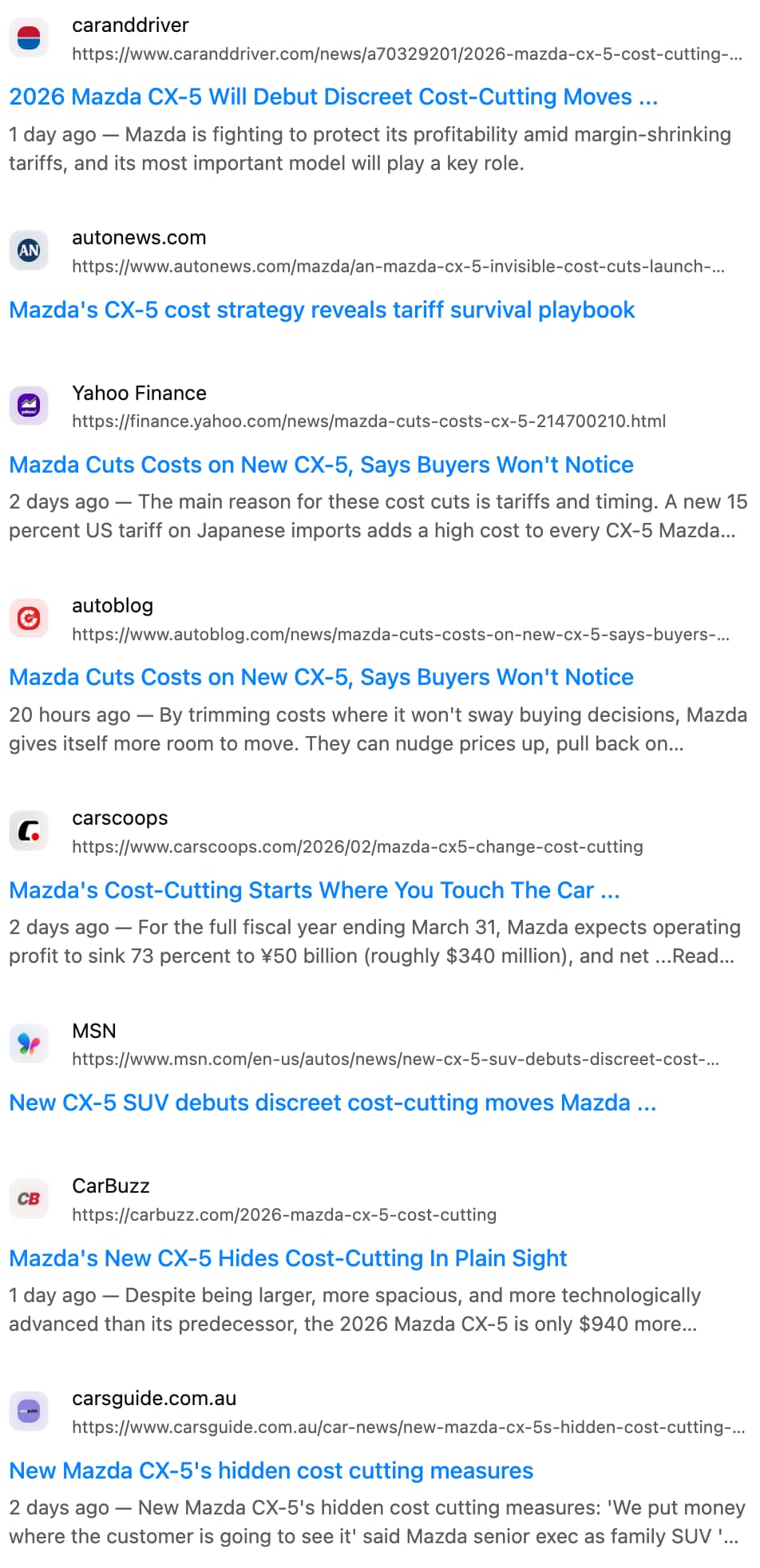
Many of these sites will review the CX-5 in the near future, and this communication invites scrutiny of how “many, many, many unseen cost cuts” may have impacted the new CX-5.
Mazda benefits disproportionately from strong early reviews through outlets like these. Favorable reviews reinforce Mazda’s long-standing positioning around driving feel and design cohesion; weak ones can linger in search results and cross-shopping discussions. While customer response to the new CX-5 will ultimately drive results, automotive publications and enthusiasts will play an outsized role in shaping the narrative.
Mazda’s level of candor makes sense only if it believes the product will withstand scrutiny. It’s betting customers value bigger and better screens and is catering to that with a large-for-the-segment 15.6-inch screen.
Mazda’s brand benefits from enthusiast credibility, even though most of its buyers are not enthusiasts. That creates a structural tension: it must preserve the driving and design qualities that earn favorable reviews while allocating capital toward the features mainstream customers reward.
Reviewers and enthusiasts have trended skeptical to negative around industry trends like removal of physical controls in favor of screens and interior material changes.
This comes through in the Car and Driver reaction:
[We] can make an educated guess that ditching the compact SUV's previously plentiful physical switchgear was most likely one of the strategic moves.
Mazda’s emphasis on evaluating what customers value as it considers where to spend asks the public, and automotive media and enthusiasts in particular, to evaluate the changes in that context instead of against a nostalgic standard.
The press does own that its preferences don’t perfectly match mainstream customers. Car and Driver even jokes about it in the Volkswagen article linked in the above reaction:
Volkswagen is listening to its customers' complaints and, more important (we're kidding), to ours, about haptic controls.
Car and Driver acknowledges that for Volkswagen (or Mazda), what customers want and need is most important.
The ongoing media and enthusiast resistance to technology and experiential shifts in cars often reads as nostalgic pining, but is in significant part a reflection of transitional pain: buttons, controls, and other elements that are being removed aren’t always being replaced with something better. The future being pursued might be compelling, but the current period is filled with highs and lows—demonstrated by the Volkswagen haptics example—as automakers figure out how to bring screens, voice, sensors, AI, and other elements together into an improved experience.
In this time of shifting capital priorities and customer expectations, it’s on Mazda to deliver in the new CX-5 an experience that provides enough driving dynamics, aesthetic, and qualitative differentiation in a way that’s relevant to current market realities. The question is whether Mazda has allocated its capital wisely. A byproduct of Mazda’s message is that it creates a frame for reviewers and enthusiasts to evaluate it in that context.
Framing Tradeoffs
The optimistic take is that Mazda’s candor nudges evaluation toward customer-weighted priorities rather than nostalgic baselines. It will not eliminate skepticism, but it may encourage critics to articulate where tradeoffs materially affect the experience—and where they do not.
To the extent that communicating tradeoffs openly is perceived to benefit Mazda, it will be interesting to see whether automakers take a more open posture about the tradeoffs they’re making—cost-related or otherwise—and why.
BMW and Porsche, for example, both received significant criticism for increasingly screen-centric interiors. Both saw sales remain strong.
This shows that when controversial changes are executed well, initial skepticism often gives way to acceptance. Upfront, transparent framing will not eliminate criticism, but it might shift conversations from accusation to evaluation. At the very least, framing the tradeoffs out loud provides a narrative to balance against other prevailing takes. Leaving things unstated can create interpretive space that others will fill.
Mazda has illuminated a structural tension that extends far beyond its own balance sheet. Over time, it will become clear whether this is a fleeting earnings-call moment, a misstep that undermines brand confidence, or a repeatable model for communicating tradeoffs.