
Ferrari Q2 2026 Earnings
Q2 shows how portfolio renewal and personalizations sustain growth, while Luce exposes the tension between expanding the offer and preserving Ferrari’s brand
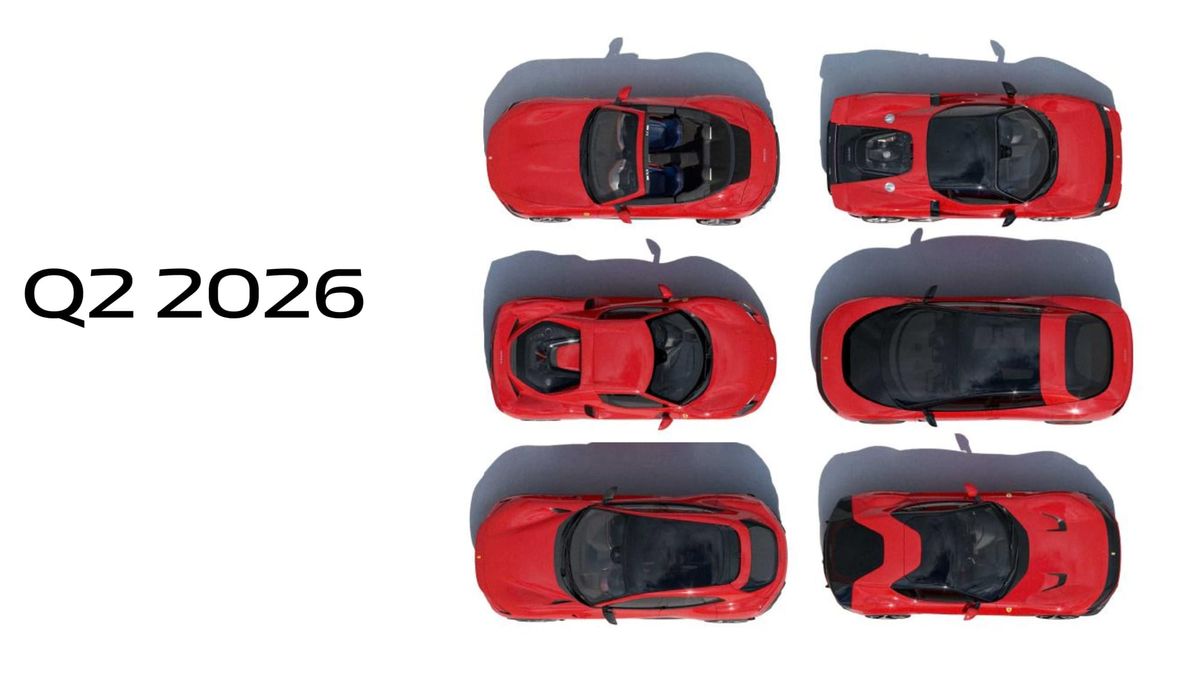
Ferrari’s second-quarter earnings show how its ongoing portfolio renewal and personalizations support growth even when shipments fall. Revenues were €1.938 billion, up 8%, and EBIT was €605 million, an increase of 10%, despite a 3.7% decrease in shipments to 3,366.
For the first half, revenue and operating profit grew while Ferrari sustained an operating margin of about 30% even as shipments declined. Ferrari raised its 2026 earnings guidance. It previously met the revenue and operating profit objectives in its 2022–2026 Strategic Plan a year early.
| Metric | Q2 2026 | H1 2026 |
|---|---|---|
| Shipments | 3,366; −3.7% | 6,802; −4.0% |
| Revenue | €1.938B; +8% | €3.786B; +6% |
| EBIT | €605M; +10% | €1.153B; +5% |
| EBIT margin | 31.2%, from 30.9% | 30.5%, from 30.6% |
CEO Benedetto Vigna’s uplifting opening quote in the earnings release also highlights the tension Ferrari faces as it looks forward:
In a single quarter, we introduced the Ferrari Luce and the Ferrari 12Cilindri Manuale: two very different sports cars that embody the same Ferrari DNA and demonstrate how we blend tradition and innovation in unique ways.
The 12Cilindri Manuale represents Ferrari innovating with current technologies to restore a traditional Ferrari experience. It’s designed to delight Ferrari’s existing client base and is fully allocated.
The Luce extends Ferrari into a different kind of car and experience—designed to expand its appeal—and has drawn criticism over its Ferrari identity, even as Vigna reports orders from both new and existing clients are in line with expectations.
The question is whether Luce and an expanded Ferrari can preserve the brand’s meaning.
Ongoing Portfolio Renewal
Ferrari attributed the shipment decrease to a planned model changeover. Ferrari continually renews its portfolio, replacing revenue from outgoing models with revenue from newer ones. The brand uses special editions, like the F80, and personalizations to drive disproportionately high revenue, which together helped offset the impact of lower shipments in Q2.
“Range Models”—Ferrari’s version of mainline vehicles—enter production, ramp up, mature, then phase out and are replaced by successors:
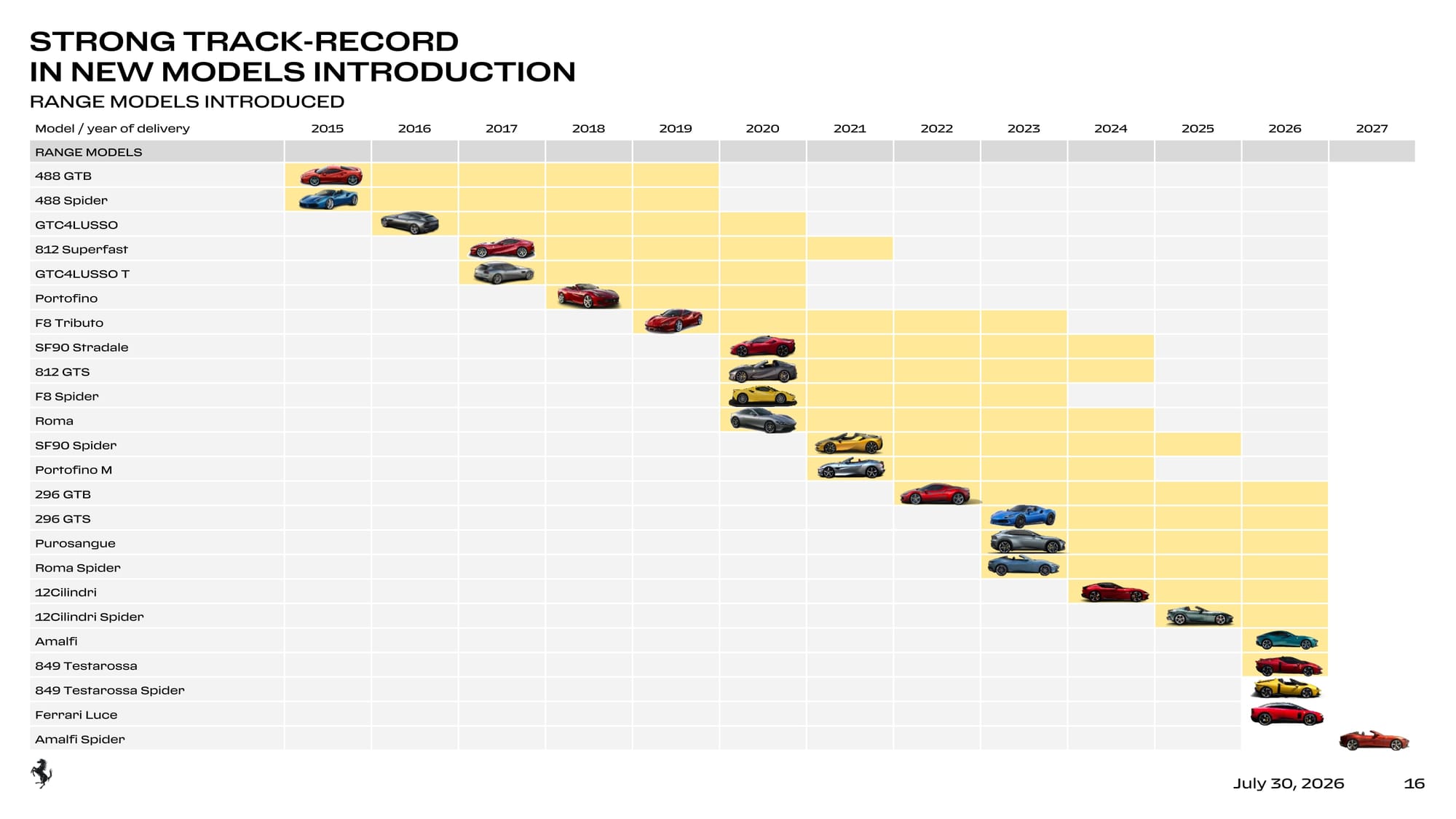
Unlike many automakers that carry model names across generations, Ferrari often gives incoming models new names even when there’s continuity with a previous generation, creating a distinct identity that can increase value and drive repeat purchasing.
There are 13 distinct model names in the visual above (not including variants like GTS or Spider), but across most of this history there were effectively five roles in the range: mid-engined two-seaters (488, F8, 296), 12-cylinder two-seaters (812, 12Cilindri), four-seat tourers (GTC4LUSSO, Purosangue), front-engine 8-cylinder GTs (Portofino, Roma, Amalfi), and upper mid-engine hybrids (SF90, 849 Testarossa). These categories tend to share a lineage, though some models, like the Purosangue, the brand’s first four-door, represent a significant departure from their predecessors. The Luce adds battery-electric power to this mix.
In Q2, deliveries of the 12Cilindri, 12Cilindri Spider, Purosangue, and 296 Speciale family increased; the Amalfi and 849 Testarossa continued to ramp up; and the 296 GTS, Roma Spider, and SF90 XX wound down as they’re phased out.
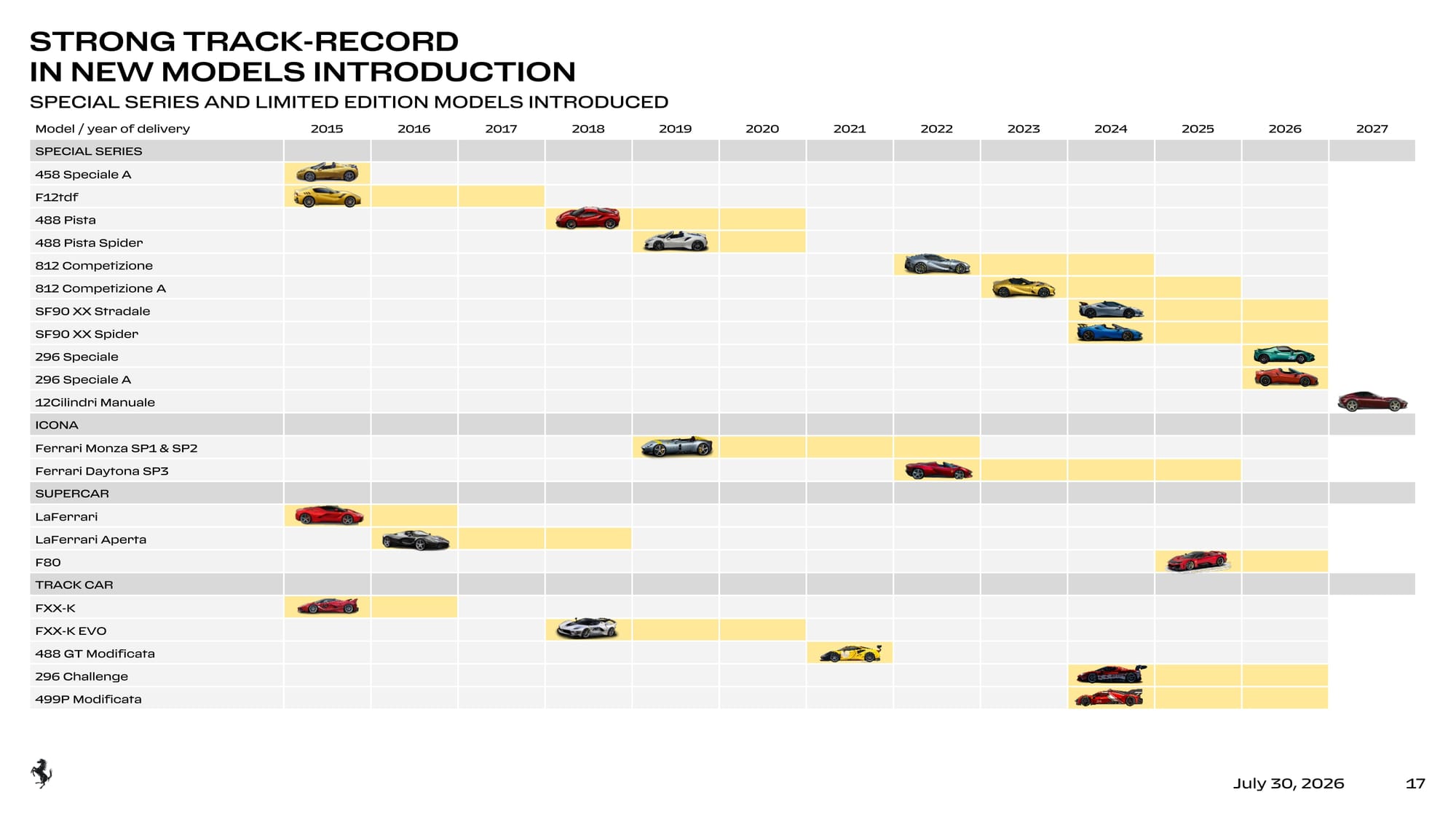
Some Range Models receive special-series derivatives whose production overlaps that of the range car and extends that family’s commercial life. These models and Ferrari’s limited-edition models command a significant premium beyond Range Models.
The F80 supercar accounted for about 1% of shipments yet was the primary product-mix contributor for Q2, underscoring the unique role limited-edition cars play in Ferrari’s model.
Volume Control
2026’s shipment pattern is typical of Ferrari since it published its 2022–2026 Strategic Plan, which “privileges revenue over volume” and identified mix/price as the main contributor to its 2026 EBIT ambition. The strategy’s impact became especially visible in 2023 as shipment growth slowed from 18.5% in 2022 to 3.3% in 2023, while revenue rose 17.2%.
Ferrari’s shipments have remained in the 13,000–14,000 range since, as revenue, EBIT, and margins have risen:
| Year | Shipments | YoY growth | Revenue (€M) | YoY growth | Adj. EBIT (€M) | YoY growth | EBIT margin | YoY change (pp) |
|---|---|---|---|---|---|---|---|---|
| 2022 | 13,221 | +18.5% | 5,095 | +19.3% | 1,227 | +14.1% | 24.1% | −1.1 pp |
| 2023 | 13,663 | +3.3% | 5,970 | +17.2% | 1,617 | +31.8% | 27.1% | +3.0 pp |
| 2024 | 13,752 | +0.7% | 6,677 | +12% | 1,888 | +16.7% | 28.3% | +1.2 pp |
| 2025 | 13,640 | −0.8% | 7,146 | +7.0% | 2,110 | +12% | 29.5% | +1.2 pp |
Ferrari doesn’t publish model-specific shipment numbers in its financials and tends to communicate delivery expectations as limits. In the 2022 plan, it said the Purosangue would comprise below 20% of annual average deliveries over its lifecycle, while Special Series would represent around 10% on average, and Icona and Supercars would account for less than 5% on average over the 2022–2026 plan period.
In the context of the 2022 plan, Q2’s use of the F80 as a low-volume contributor and leveraging personalizations represent the company delivering per its strategy. More broadly, Ferrari has shown it can grow revenue and profit without growing shipments and, in some cases—like in Q2—with fewer shipments.
The brand’s 2025 revenue of €7.146 billion and EBIT of €2.110 billion already exceeded the plan’s 2026 ambition of up to €6.7 billion and €1.8–2.0 billion, and its 29.5% EBIT margin was toward the upper end of the 27–30% target range.
Ferrari’s 2030 target is approximately €9 billion in revenue, representing a compound annual growth rate of around 5%, with at least €2.75 billion EBIT and at least 30% margin. It cites primary drivers as product mix, including limited-edition models, an enriched product range—its 2030 Strategic Plan says an average of four new car launches per year from 2026 through 2030—and personalizations.
Ferrari also said, “volume is projected to positively contribute, although at a lesser extent.” Some clear, though non-specific, acknowledgments of Ferrari’s intent to increase shipments come from its 2025 Annual Report.
From the Risk Factors section (page 28):
A key to the appeal of the Ferrari brand and our marketing strategy is the aura of exclusivity and the sense of luxury which our brand conveys. A central facet to this exclusivity is the limited number of models and cars we produce and our strategy of maintaining our car waiting lists to reach the optimal combination of exclusivity and client satisfaction. Our controlled volume strategy is also an important factor in the prices that our clients are willing to pay for our cars.
[…]
On the other hand, our controlled volume strategy contemplates a measured increase in shipments above current levels as we target a larger customer base and modes of use, we increase our focus on periodically rejuvenating our customer base and creating new Ferrari collectors, and our product portfolio evolves with a broader product range.
Later, in Trends, Uncertainties, and Opportunities (page 94), in the first point, “Controlled Volume Strategy and Brand Exclusivity”, after noting the four launches per year commitment mentioned above:
This is consistent with our “different Ferrari for different Ferraristi” and “different Ferrari for different moments” strategies, as we continue to broaden and diversify our product offering, and target a potentially larger and younger customer base, while preserving and enhancing the exclusivity and longterm value of our brand, through the exclusivity of our products.
All of the above suggest Ferrari intends to grow its shipment level through a broader range of cars for different customers and usage scenarios, while continuing to limit each model’s volume to maintain exclusivity.
Risks and Opportunities
The Purosangue—Ferrari’s first four-door—represents a more general-purpose usage model than most Ferraris. Ferrari said Purosangue would comprise less than 20% of the brand’s annual average shipments over its lifetime; a ceiling close to one-fifth of shipments for this single model signals that Ferrari envisions a significant role for it.
It’s hard not to see the Luce, which also has four doors and is a BEV, as having a broader functional and younger-buyer appeal. It’s also the face of the challenge in front of Ferrari as it attempts to expand.
If Ferrari wanted to grab the world's attention with the Luce, its first all-electric car, mission accomplished - even if much of the reaction has been shock and outrage.
The new model is a four-door, five-seat family car that looks nothing like the Italian marque's usual fare of low-slung, petrol-powered sports cars.
[…]
But the styling, largely the work of auto industry outsiders Jony Ive and Marc Newson and their collective LoveFrom, has left many fans and commentators baffled. Ive is best known as the designer of Apple's iPhones and MacBooks.
Social media is awash with unflattering memes, comparing the Luce variously to a vacuum cleaner, a rubber clog or the much-maligned Fiat Multipla, a 1990s people carrier often cited among the world's ugliest cars.
Italian Deputy Prime Minister Matteo Salvini publicly wondered what founder Enzo Ferrari, who died in 1988, would make of it. Former Ferrari CEO Luca Cordero di Montezemolo said the car should be stripped of the prancing horse logo.
CEO Vigna said orders met expectations and both new and existing clients are buying:
Presenting second quarter results, Vigna said that, two months after the launch, the company was "very pleased with how orders are proceeding".
"It's in line with our expectations. Clients who put orders in are both existing and new ones, and this too is in line with our expectations," he told reporters, adding that the Luce had not changed Ferrari's future EV plans.
"When clients see the car, they're really enthusiastic and happy," Vigna said, dismissing suggestions that Ferrari was resorting to aggressive marketing or pressure on loyal customers to push sales.
[…]
Ferrari has already hit the Luce's 2026 annual sales target of just under 500 units thanks to strong demand from China, the Financial Times reported on Wednesday, citing people familiar with the matter.
Vigna on Thursday said interest for the model was evenly spread around the world.
Ferrari has shown it can grow without additional volume over a sustained period. It has carefully measured its shipments to protect its brand and business model. The brand’s risk in expanding to new audiences and uses is disagreement over what makes a Ferrari a Ferrari; if that meaning is diluted or lost, the desirability that undergirds its economics will follow.